Key Takeaways
- Oklahoma recorded 2,113 prescription opioid overdose deaths between 2011 and 2015 while dispensing over 326 million pills, showing how prescription-origin addiction became a statewide public health issue.12
- State and CDC prescribing guidelines specifically advise against detoxification alone and direct providers to offer evidence-based medications like methadone, buprenorphine, or naltrexone for opioid use disorder.3, 8
- Where you receive care in Oklahoma depends on the medication and structure needed: methadone runs through certified OTPs, buprenorphine works in office-based settings, and residential programs coordinate across levels.1,2
- SoonerCare covers medically necessary MAT including methadone through certified programs, and keeping naloxone at home is recommended for anyone prescribed opioids, even during a taper.7,13
When the Bottle in Your Cabinet Became the Problem
It probably didn’t start in a dark place. It started after a surgery, a car wreck, a back that would not stop screaming, or a dental procedure that went sideways. Someone in a white coat wrote your name on a prescription, and for a while, the pills did what they were supposed to do. The pain got quieter. You could sleep. You could work.
Then something shifted. Maybe the same dose stopped touching the pain. Maybe you noticed you were watching the clock, counting hours until the next one. Maybe the script ran out and your body reminded you, hard, that it had gotten used to the medicine. Restless legs. Sweats at 3 a.m. A knot of anxiety you did not have before. And somewhere in there, a thought you have not said out loud to anyone: I don’t think I can stop on my own.
If that is where you are, you are not a stereotype. Prescription opioids like oxycodone are useful for pain, and they also carry real risks of dependence, misuse, and overdose. What began as treatment can become its own condition, and that condition has a name and a path out. This guide walks you through what oxycodone addiction treatment actually looks like in Oklahoma, so the next step feels less like a cliff and more like a door.5
How a Legal Prescription Turns Into Dependence
The Path From Pain Relief to Physical Need
Here is the part nobody warns you about at the pharmacy counter. Your brain adapts to oxycodone. That is not a character flaw. That is chemistry. The same dose that dulled the pain in week one starts to feel thinner by week three, and by week six your body has quietly recalibrated around the medicine being there. When it is not there, you feel it. Not just in the original injury, but in your skin, your sleep, your mood.
Modern prescribing guidance is built to slow that slide. The CDC’s 2022 clinical guideline pushes for the lowest effective dose and the shortest duration that actually treats your pain, plus regular check-ins to catch trouble early. Oklahoma’s state prescribing guidelines echo that approach and add something important for anyone reading this: providers should offer or refer patients to evidence-based treatment for opioid use disorder, and detoxification on its own is not recommended.3,9
Signs You Have Crossed From Use Into Opioid Use Disorder
You may already know, in the quiet part of your day, that something has shifted. Naming it out loud is harder. Here is what clinicians actually look for, in plain language:
- You take more than the label says, or take it longer than your prescriber intended.
- You have tried to cut back and could not, even when you meant it.
- A lot of your day is organized around the medicine — refills, pharmacies, planning around when the next dose lands.
- Cravings show up, sometimes out of nowhere.
- Work, driving, parenting, or relationships have taken a hit, and you have kept using anyway.
- You need more to get the same relief (tolerance), or you feel sick when you stop (withdrawal): bone aches, restless legs, sweats, diarrhea, anxiety that spikes at 4 a.m.
- You have kept using even after a scare — a near miss, a doctor’s warning, a family conversation you did not want to have.
If several of those sound like your last few months, that is what opioid use disorder looks like from the inside. It does not mean you are weak, and it does not mean you are a person you never wanted to be. It means the pill bottle stopped being a treatment and started being a problem, and that problem has its own treatment.5
The Prescription-Opioid Problem in Oklahoma, in Plain Numbers
You are not alone in this, and the numbers make that painfully clear. Between 2011 and 2015, Oklahoma recorded 2,113 prescription opioid overdose deaths, while more than 326 million opioid pills were dispensed to residents in that same five-year window. That is not a story about a fringe problem in a back alley. That is pills passing across pharmacy counters in Tulsa, Shawnee, Enid, Lawton, and yes, Oklahoma City — going home in paper bags with people who had a diagnosis and a doctor’s signature.12
Sit with that ratio for a second. Hundreds of millions of legally prescribed pills. Thousands of deaths tied specifically to prescription opioids. Somewhere in that gap is the honest picture of how a pain plan can turn into a funeral, and how many Oklahomans have watched it happen up close.
The state keeps tracking the damage. Oklahoma’s Drug Overdose Data Dashboard now lets residents and families pull fatal and nonfatal overdose numbers by county, demographics, and substance, so you can see what is happening in your own zip code rather than a national average. A more recent state fact sheet lays out overdose mortality trends from 2019 through 2023, which is useful if you are trying to understand where the risk sits today, after the fentanyl wave reshaped everything.10,11
Here is the point of showing you any of this. The pill-bottle pathway is not rare, and it is not shameful. It is common enough that Oklahoma built a public dashboard around it. Treatment was built for this too.

Why Detox Alone Will Not Hold you
You may have already tried the short version. A hospital stay. A rough week at your sister’s house with a trash can beside the bed. A rapid taper your doctor called “the plan.” And then, a few weeks or a few months later, you were back where you started, or somewhere worse. That is not a moral failing. That is what the evidence predicts.
Both the CDC and Oklahoma’s own prescribing guidelines are blunt about this: clinicians should offer or arrange evidence-based medications for opioid use disorder, and detoxification on its own is not recommended. Getting the oxycodone out of your system is a start, not a treatment. Your body clears the drug in days. Your brain’s reward wiring, your sleep, your pain thresholds, and the anxiety that made the pills feel like relief in the first place all take longer. Without medication and structured support, the return of cravings usually beats your willpower to the finish line.3,4
There is another risk people underestimate after a detox-only stint. Your tolerance drops fast. If you use again at anything close to your old dose, the same amount that felt normal in July can stop your breathing in September. That is why real treatment pairs medication, counseling, and monitoring with a plan for what happens on day 30, day 90, and month six. You do not need to be strong enough to do this alone. You need a plan that does not ask you to.8
The Three Medications That Actually Treat Oxycodone Addiction
Methadone, Buprenorphine, and Naltrexone Compared
When a doctor talks about “medications for opioid use disorder,” they are usually talking about three specific ones. NIDA lists methadone, buprenorphine, and naltrexone as the FDA-approved options for treating opioid use disorder. All three work. They just work differently, and one of them will probably fit your situation better than the other two.8
Here is the short version of each, in language that will not require a pharmacology degree.
- Methadone
- A long-acting opioid that steadies your brain’s opioid system at a controlled level. No highs, no crash, no clock-watching. It is well-studied for people with heavier dependence, longer histories, or a hard time staying stable on lighter medications. In Oklahoma, methadone for OUD is dispensed only through certified opioid treatment programs, which the state calls OTPs. That means daily visits at first, then take-home doses as you earn stability.2
- Buprenorphine
- (Often the Suboxone formulation, which pairs it with naloxone.) A partial opioid agonist. It quiets cravings and withdrawal without producing the same reinforcing effect as a full opioid. It can be prescribed in an office-based setting, which Oklahoma refers to as OBOT — you see a regular clinician, fill at a regular pharmacy, and live your regular life. For a lot of people whose story started with a pill bottle, this is the least disruptive option.1
- Naltrexone
- Not an opioid at all. It blocks the receptors, so if you took oxycodone on top of it, you would feel nothing. The extended-release injectable form (Vivitrol) is given monthly. It requires a full opioid-free period first, which is why it often comes after residential care rather than at the very start.
| Medication | How it works | Where you get it in Oklahoma | Often a good fit when |
|---|---|---|---|
| Methadone | Full opioid agonist, long-acting | Certified OTP only 2 | Longer or heavier dependence; other options have not held |
| Buprenorphine | Partial opioid agonist | Office-based (OBOT) or OTP 1 | You want to keep working and stay in your community |
| Naltrexone (Vivitrol) | Opioid receptor blocker, non-opioid | Office or clinic, monthly injection 8 | You have finished withdrawal and want a non-opioid option |
None of these is a moral upgrade over the others. The right one is the one that keeps you alive, functional, and out of the cycle.
Where You Get These Medications in Oklahoma
Oklahoma has built out a statewide structure so you do not have to drive to Dallas or Kansas City for evidence-based care. ODMHSAS provides MOUD services — including office-based opioid treatment and OTP/methadone clinics — to individuals and families across the state. That is true whether you are in Oklahoma City, Tulsa, Shawnee, Lawton, or a smaller town where the nearest stoplight is a mile away.1
The two settings work differently, and it helps to know which door you are walking through.
OBOT (office-based opioid treatment) is what it sounds like. You see a licensed clinician in a regular office, get a buprenorphine prescription if that fits, and fill it at your pharmacy. Follow-ups are usually monthly once you are stable. This is often where prescription-origin cases start because the setting looks and feels like the primary care you are already used to.
OTPs (opioid treatment programs) are certified by ODMHSAS specifically to provide FDA-approved medications, including methadone, along with counseling and monitoring. If methadone is on the table, an OTP is where you will go. Early on that means showing up most mornings; over time, take-home privileges expand.2
Residential programs like Country Road Recovery in Pink work alongside this system. If MAT is part of your plan, ask specifically how they coordinate with an OBOT prescriber or OTP so your medication does not lapse between levels of care.

What Real Treatment Looks Like Beyond the Medication
Residential, PHP, and IOP Levels of Care
Medication does the biological heavy lifting. Everything else — the sleep, the pain plan, the honest conversations, the reason you started taking more than the label said — happens in a level of care that fits your life. Oklahoma programs generally offer three, and they are not a ladder you have to climb in order. They are matched to how much structure your recovery needs right now.
Residential treatment is 24-hour care. You live on-site, usually for a few weeks to a couple of months. This is where people go when home is not safe, when a taper has failed twice, when the pills are still in the medicine cabinet, or when the pain and anxiety are loud enough that outpatient appointments alone will not hold. Meals, sleep, therapy, and medication are all under one roof.
Partial hospitalization (PHP) is a step down. You are in structured programming most of the day, most days of the week, but you sleep at home or in sober housing. It works well when you are stable on medication but still need daily therapeutic contact.
Intensive outpatient (IOP) is a few sessions a week, usually in the evening. This is where a lot of prescription-origin cases land eventually — you keep your job, you keep your family routine, and you keep your recovery work in the same week.
Dual Diagnosis: Treating the Pain, Anxiety, and Trauma Underneath
Nobody starts taking more oxycodone than prescribed for no reason. There is almost always something underneath — the original pain that has not gone away, an anxiety disorder the pills quieted before you knew you had one, a trauma history the medicine muffled, insomnia that turned into a nightly negotiation with the bottle. If treatment only addresses the opioid and ignores what the opioid was doing for you, you are going to be miserable, and then you are going to relapse.
Dual diagnosis care is the honest version of treatment. It means a clinician looks at the substance use and the mental health picture together, not as two separate problems handed off between two separate providers. For a prescription-origin case, that usually means an ongoing pain plan that does not rely on opioids — physical therapy, non-opioid medications, sleep work, movement — alongside therapy for depression, PTSD, or anxiety if any of those are part of your story.
Evidence-based approaches like cognitive behavioral therapy and dialectical behavior therapy give you tools for the moments when a craving lands. Trauma-focused therapy does the deeper work for people whose pain was never only physical. And experiential work — equine therapy, art therapy, time outside — is not decoration. For a nervous system that has been chemically regulated for years, learning to feel calm without a pill is a skill you rebuild slowly, in your body, not just in a conversation.
Country Road Recovery in Pink and Tecumseh
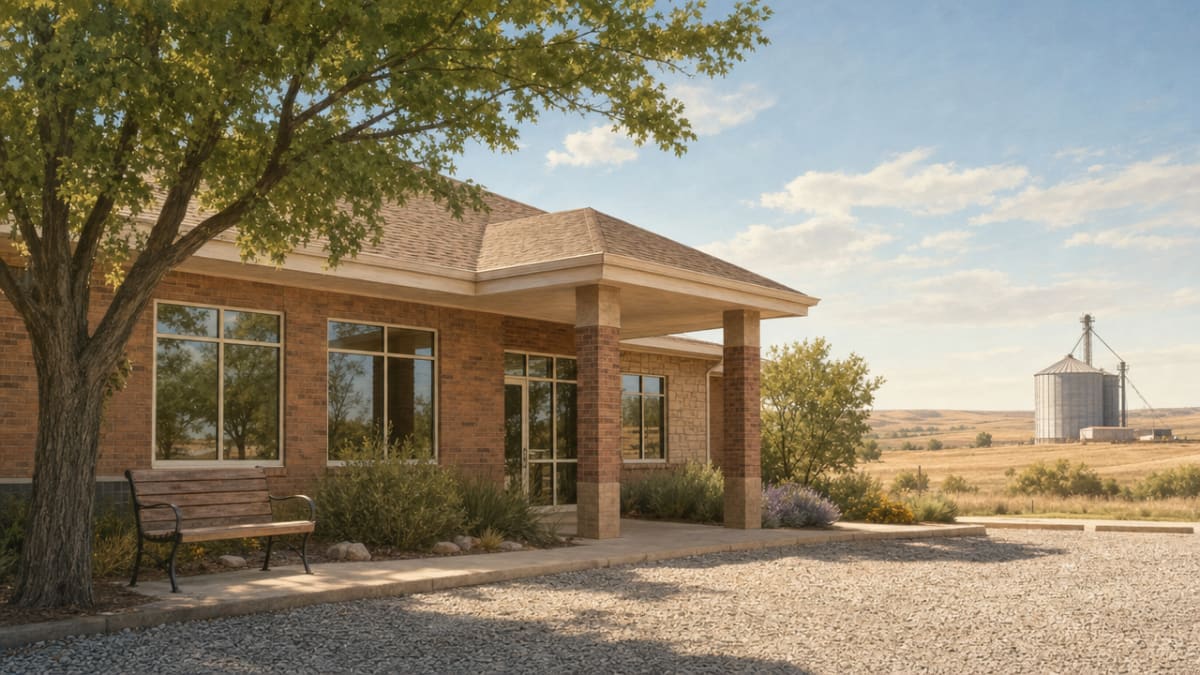
Country Road Recovery sits on 136 acres in Pink, Oklahoma, a short drive from Shawnee and about 45 minutes east of Oklahoma City. The setting matters more than it sounds like it should. When your last few years have been organized around pharmacy runs, refill dates, and the low hum of watching yourself, an open pasture and a quiet road change something. There is space to sleep. Space to think. Space to be around people who are not asking anything of you except that you show up to the next group.
The program is co-ed and built for adults 18 and up, with residential, PHP, and IOP under the same clinical team so your care does not restart every time your level changes. Dual diagnosis is the core of the work, not an add-on. CBT, DBT, and trauma-focused therapy sit alongside equine therapy, art therapy, and other experiential pieces. There is a dedicated track for veterans, family education programming, and an alumni community that stays active after you leave.
One detail worth naming: many staff members at Country Road are in long-term recovery themselves. If you have spent years feeling misunderstood by people who have only read about this in a textbook, that difference lands quickly.

Paying for Treatment: SoonerCare, Private Insurance, and Tricare
Money is often the reason people wait another six months to call, and another six months after that. Let’s take some of that fog out of the way.
If you have SoonerCare (Oklahoma’s Medicaid program), medically necessary medication-assisted treatment for opioid use disorder is a covered benefit for eligible members, including methadone treatment delivered through certified opioid treatment programs. That coverage exists specifically because the state recognized OUD as a treatable medical condition, not a lifestyle problem. If you are not sure whether you qualify, apply anyway. People are often surprised.13
If you carry private insurance through your job or the marketplace, most major plans cover residential treatment, PHP, IOP, and MAT to varying degrees. What you actually pay depends on your deductible, whether the program is in-network, and how your plan defines medical necessity for each level of care. A short call to the admissions team at any Oklahoma provider — Country Road included — will get you a benefits check before you commit to anything.
If you are a veterans or military family member, Tricare East is the coverage most Oklahoma programs work with, and Country Road Recovery accepts it alongside a dedicated veteran track. Ask specifically how they support clients whose opioid use began with a prescription — the answer should include how MAT, dual diagnosis therapy, and pain planning fit together, not just a bed count.
Naloxone at Home, Even If You Are Still Tapering
Buy a two-pack of nasal spray. Put one in your bedroom and one where a family member can reach it. Tell one person you trust where it is and what an overdose looks like — slow or stopped breathing, blue lips, unresponsive to a sternum rub. If you are tapering, your tolerance is shifting. If you slip, even once, at your old dose, the risk is real. Naloxone is the seatbelt for a road you are trying to leave.6
How to Take the Next Step Without Blowing Up Your Life
You do not have to announce anything to anyone today. You do not have to quit your job, tell your boss, or hand your kids a speech. What you have to do is smaller than that, and honestly harder: make one phone call, or let someone make it with you.
A first call to an Oklahoma program is not a commitment. It is a conversation. You describe what you are taking, how long it has been going on, what your insurance looks like, and what you are afraid will happen if you step away from work or home. The person on the other end has heard the prescription-origin story before. Many times.
If Country Road Recovery is on your list, ask specifically how they support clients whose opioid use began with a legitimate prescription — how they coordinate MAT with an OBOT prescriber or OTP, how they handle ongoing pain without opioids, and what family and work communication looks like while you are in care. Bring naloxone home in the meantime. Then make the call. That is the next step. Not the last one, just the next one.1,14
Start your recovery from prescription opioid misuse
Connect with a supportive team ready to guide your next steps toward lasting change.
Frequently Asked Questions
Do I really have an addiction if my oxycodone use started with a legitimate prescription?
Yes, and how it started does not change the diagnosis or the treatment. Prescription opioids carry real risks of dependence and misuse even when taken as directed. If you are taking more than prescribed, cannot cut back, or feel withdrawal when you stop, that is opioid use disorder — a medical condition with evidence-based treatment, not a character issue.5
Will SoonerCare or my private insurance cover oxycodone addiction treatment in Oklahoma?
SoonerCare covers medically necessary medication-assisted treatment, including methadone through certified opioid treatment programs, for eligible members with opioid use disorder. Most major private plans cover residential, PHP, IOP, and MAT at varying levels depending on your deductible and network. A benefits check with the admissions team at any Oklahoma program will tell you exactly what applies to you.13
Is medication-assisted treatment just replacing one opioid with another?
No. Methadone and buprenorphine work on the same receptors oxycodone did, but at steady, controlled levels that quiet cravings and withdrawal without producing a high or a crash. Naltrexone is not an opioid at all — it blocks the receptors. All three are FDA-approved treatments for opioid use disorder, and evidence-based care specifically recommends against detox alone.4,8
How long does oxycodone withdrawal last, and can I get through it without inpatient care?
Acute withdrawal — bone aches, restless legs, sweats, insomnia, anxiety, diarrhea — usually runs about a week, with lingering sleep and mood issues for weeks after. Some people manage outpatient withdrawal with buprenorphine and close medical support. Others need residential care, especially if past tapers failed. Detox alone is not recommended as a stand-alone treatment; pair it with MAT.3,4
What happens to my chronic pain if I stop taking oxycodone?
Your pain does not vanish, and honest treatment does not pretend it will. A dual-diagnosis program builds a non-opioid pain plan alongside your recovery work: physical therapy, non-opioid medications, sleep and anxiety treatment, movement, and body-based therapies. Many people find their pain becomes more manageable once the tolerance-and-withdrawal cycle ends, because oxycodone itself often amplifies pain sensitivity over time.
Can I keep my job and privacy while going to treatment in Oklahoma?
Often, yes. Intensive outpatient runs a few evenings a week, and PHP works around a modified schedule. If you need residential care, FMLA and short-term disability may protect your job — admissions teams help with the paperwork. Treatment records are protected under federal privacy rules, and you decide who gets told what. Ask any program specifically how they handle work communication before you commit.
References
- Medications for Opioid Use Disorder – Treatment – Oklahoma.gov. https://oklahoma.gov/odmhsas/treatment/adult-family-treatment-services/moud.html
- Chapter 70. Standards and Criteria for Opioid Treatment Programs. https://oklahoma.gov/content/dam/ok/en/odmhsas/documents/policy/provider-certification/administrative-rules/2025/PC–Chapter-70_9_15_2025.pdf
- OKLAHOMA OPIOID PRESCRIBING GUIDELINES. https://oklahoma.gov/content/dam/ok/en/health/health2/aem-documents/prevention-and-preparedness/injury-prevention/drug-overdose/oklahoma-opioid-prescribing-guidelines.pdf
- Guideline Recommendations and Guiding Principles – CDC. https://www.cdc.gov/overdose-prevention/hcp/clinical-guidance/recommendations-and-principles.html
- About Prescription Opioids | Overdose Prevention. https://www.cdc.gov/overdose-prevention/about/prescription-opioids.html
- Lifesaving Naloxone | Stop Overdose. https://www.cdc.gov/stop-overdose/caring/naloxone.html
- Discuss naloxone with all patients when prescribing opioids. https://www.fda.gov/drugs/drug-safety-communications/fda-recommends-health-care-professionals-discuss-naloxone-all-patients-when-prescribing-opioid-pain
- Medications for Opioid Use Disorder. https://www.nida.nih.gov/research-topics/medications-opioid-use-disorder
- CDC Clinical Practice Guideline for Prescribing Opioids for Pain — United States, 2022. https://www.cdc.gov/mmwr/volumes/71/rr/rr7103a1.htm
- Drug Overdose Data Dashboard – Oklahoma.gov. https://oklahoma.gov/health/health-education/injury-prevention-service/drug-overdose/data/drug-overdose-data-dashboard.html
- Drug Overdose Deaths, 2019-2023 – Oklahoma. https://oklahoma.gov/content/dam/ok/en/health/health2/aem-documents/prevention-and-preparedness/injury-prevention/drug-overdose/2025%20State%20Drug%20OD%20-%20IPS%20-%20Fact%20Sheet.pdf
- Opioid Overdoses | Oklahoma.gov. https://oklahoma.gov/content/dam/ok/en/health/health2/documents/opioid-overdose-fact-sheet.pdf
- Okla. Admin. Code § 317:30-5-241.7 | Medication-assisted treatment (MAT) services for eligible individuals with opioid use disorder. https://www.law.cornell.edu/regulations/oklahoma/OAC-317-30-5-241.7
- How and When to Use Naloxone for an Opioid Overdose. https://www.cdc.gov/overdose-prevention/media/pdfs/2024/04/Naloxone-Fact-Sheet_FamilyandCaregivers_HowandWhen_4_11_2024.pdf


