Key Takeaways
- Benzodiazepine dependence can develop at prescribed doses, and the FDA’s class-wide boxed warning plus SAMHSA guidance advise against stopping Xanax, Ativan, or Klonopin abruptly after a month of use 4, 2.
- Oklahoma recorded 309 benzodiazepine-involved overdose deaths from 2019 to 2023, and rural provider shortages across 59 of 77 counties make specialized tapering expertise harder to reach 13, 16.
- Choosing a program in Oklahoma should weigh CARF accreditation, ODMHSAS certification, ASAM-based placement, and integrated dual diagnosis care for underlying anxiety, PTSD, or insomnia 17, 18, 3.
- Readers considering a taper should contact a qualified Oklahoma program to verify prescriber oversight, assessment frequency, coordination with existing providers, and insurance coverage before starting withdrawal 1, 19.
Understanding Benzodiazepine Dependence and Withdrawal
You likely didn’t anticipate physical dependence when prescribed Xanax, Ativan, or Klonopin. Many individuals find themselves in a situation where attempting to stop these medications leads to intense withdrawal symptoms, such as an elevated heart rate, heightened anxiety, and a general feeling of unease. This isn’t a sign of weakness; it’s your nervous system reacting to the absence of a drug it has adapted to.
Benzodiazepines alter the brain’s regulatory mechanisms. Over time, the body doesn’t just desire the medication; it requires it to maintain stability. The FDA now mandates a boxed warning for all benzodiazepines, addressing physical dependence and withdrawal, even for those taking them as prescribed 4. Federal guidelines advise against abrupt cessation after more than a month of use 2.
If you’ve experienced severe reactions when trying to quit, it’s a medical issue, not a character flaw. Medical issues require structured plans. This guide outlines what a safe withdrawal plan entails in Oklahoma and how Country Road Recovery Center provides clinical coordination to support you through this process.
The Nature of Benzodiazepine Dependence
The Class-Wide Warning
Dependence can develop even when taking benzodiazepines exactly as prescribed. It’s a chemical adaptation, not a moral failing, and can occur at therapeutic doses after just a few months of consistent use.
In 2020, the FDA updated its boxed warning for the entire benzodiazepine class to include risks of abuse, misuse, addiction, physical dependence, and withdrawal reactions 4. This is the highest level of warning issued by the agency, applying to all benzodiazepines on the market. Many individuals are unaware of this critical context when they receive their prescriptions.
SAMHSA’s 2025 federal guidance reinforces that these medications should not be stopped abruptly after more than a month of use. Any changes should be made in collaboration with a prescriber 2. If you’ve been taking these medications daily for an extended period, your body has adapted, making cessation a clinical event requiring professional guidance.
Differences Among Benzodiazepines: Xanax, Ativan, and Klonopin
While often grouped, Xanax (alprazolam), Ativan (lorazepam), and Klonopin (clonazepam) have distinct pharmacological profiles that influence withdrawal experiences and tapering strategies.
- Xanax
- Short-acting, leading to rapid onset and offset of effects. This can result in rebound anxiety within hours of a missed dose, often prompting increased usage.
- Ativan
- Has an intermediate duration of action, with effects lasting longer than alprazolam but still clearing within a day, leading to relatively quicker and more intense withdrawal timing.
- Klonopin
- Long-acting, accumulating in the body more gradually. While this can initially mask dependence, withdrawal from Klonopin can be prolonged, potentially lasting weeks.
These differences highlight why individualized tapering plans are crucial. The 2025 Joint Clinical Practice Guideline on Benzodiazepine Tapering emphasizes that clinicians must develop gradual, personalized strategies based on patient response, rather not a generic schedule 1. Factors such as the specific benzodiazepine, dosage, duration of use, and co-occurring conditions all inform a safe and effective tapering plan.
The Critical Risk of Abrupt Cessation: Seizures
Clinical reviews confirm that abrupt cessation after even one to six months of use can trigger seizures, underscoring the necessity of a gradual dose reduction 6. SAMHSA’s 2025 guidance reiterates this, stating that these medications should not be stopped abruptly after more than a month of use 2.
If you have been taking Xanax, Ativan, or Klonopin daily for several months, the safest course of action is not to stop immediately. Your brain has adapted, and sudden removal of the drug can dangerously destabilize your nervous system. The good news is that a supervised taper significantly mitigates these risks. The danger lies in attempting withdrawal alone; safety is found in a medically supervised plan that adjusts to your body’s responses, ideally within a supportive environment like Country Road Recovery Center.
Understanding Benzodiazepine Withdrawal Symptoms
Benzodiazepine withdrawal manifests as a pattern of symptoms affecting the nervous system, sleep, and cognitive function. Recognizing these symptoms can help alleviate distress.
Common clinical descriptions include:
- Sleep disturbance
- Irritability
- Tension
- Anxiety
- Tremor
- Sweating
- Nausea
- Palpitations
- Headache
- Muscle pain 8
SAMHSA highlights anxiety and sleep disturbance as prevalent symptoms, noting that severe complications, including seizures, necessitate a gradual, tapered approach 3. Therefore, symptoms like a racing heart, unexplained muscle aches, or altered sensory perceptions are not imagined; they are recognized components of benzodiazepine withdrawal.
The timing and intensity of withdrawal symptoms vary based on the specific benzodiazepine and duration of use. Shorter-acting drugs like alprazolam can induce symptoms within a day, while longer-acting clonazepam may delay onset. Regardless of the specific presentation, withdrawal is treatable, and support is available.
Benzodiazepine Use in Oklahoma: Access and Challenges
State-Level Statistics and Overdose Risks
Benzodiazepine-involved overdose deaths are a significant concern in Oklahoma. The state’s fatal overdose report recorded 309 such deaths between 2019 and 2023 13. These statistics underscore the serious risks associated with these medications, particularly when misused or combined with other substances.
A majority of these fatalities involve polysubstance use, often combining benzodiazepines with opioids, alcohol, or illicit substances. This pattern highlights the importance of comprehensive screening during intake to identify all substances in a patient’s system. A thorough assessment of co-occurring substance use is a critical component of the standard of care, ensuring that tapering plans are safe and effective.
The prevalence of these incidents emphasizes the need for coordinated care and professional support during benzodiazepine withdrawal.
Addressing Treatment Gaps in Rural Oklahoma
Geographic location significantly impacts access to specialized benzodiazepine tapering expertise in Oklahoma. With 59 of its 77 counties classified as rural, the state faces severe behavioral health provider shortages 16. This means that finding a prescriber experienced in managing Klonopin or Ativan tapers can be challenging, particularly outside urban centers.
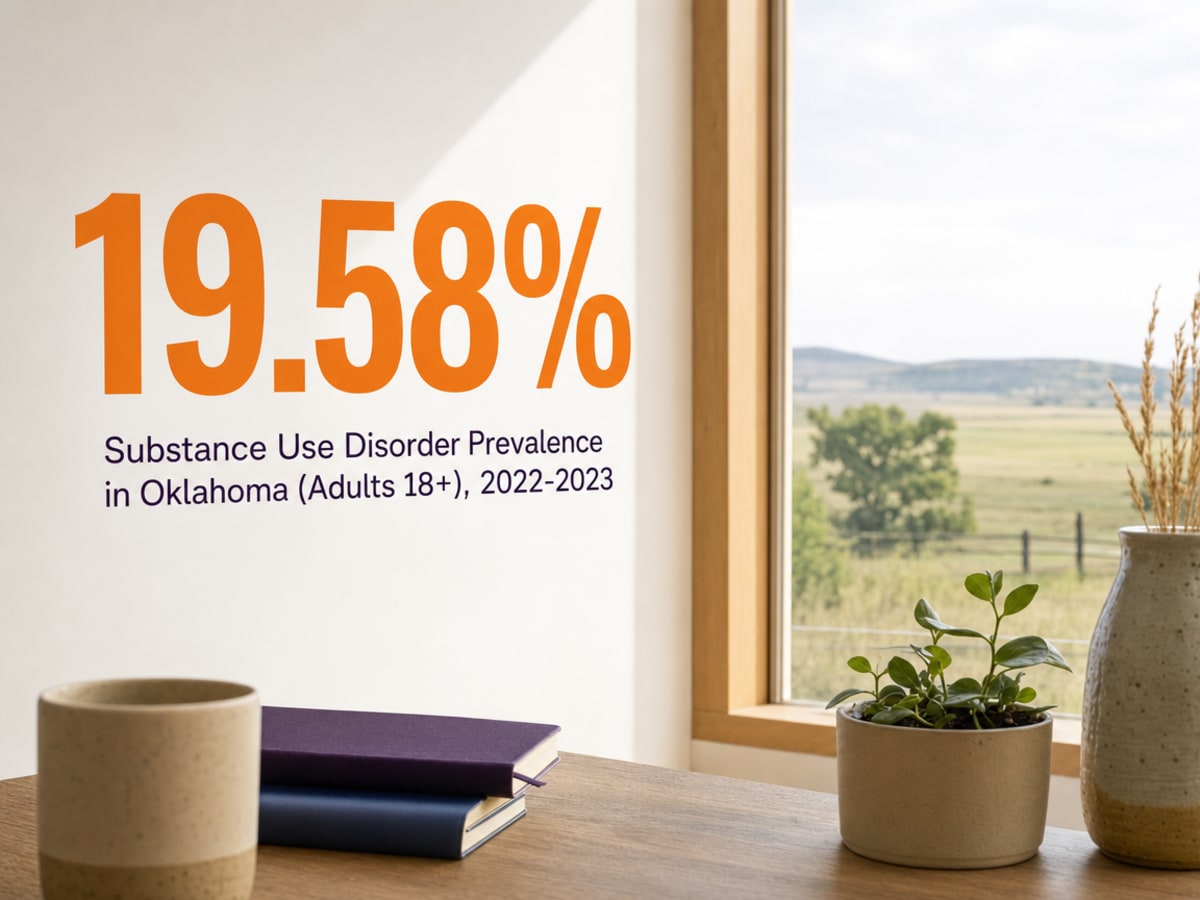
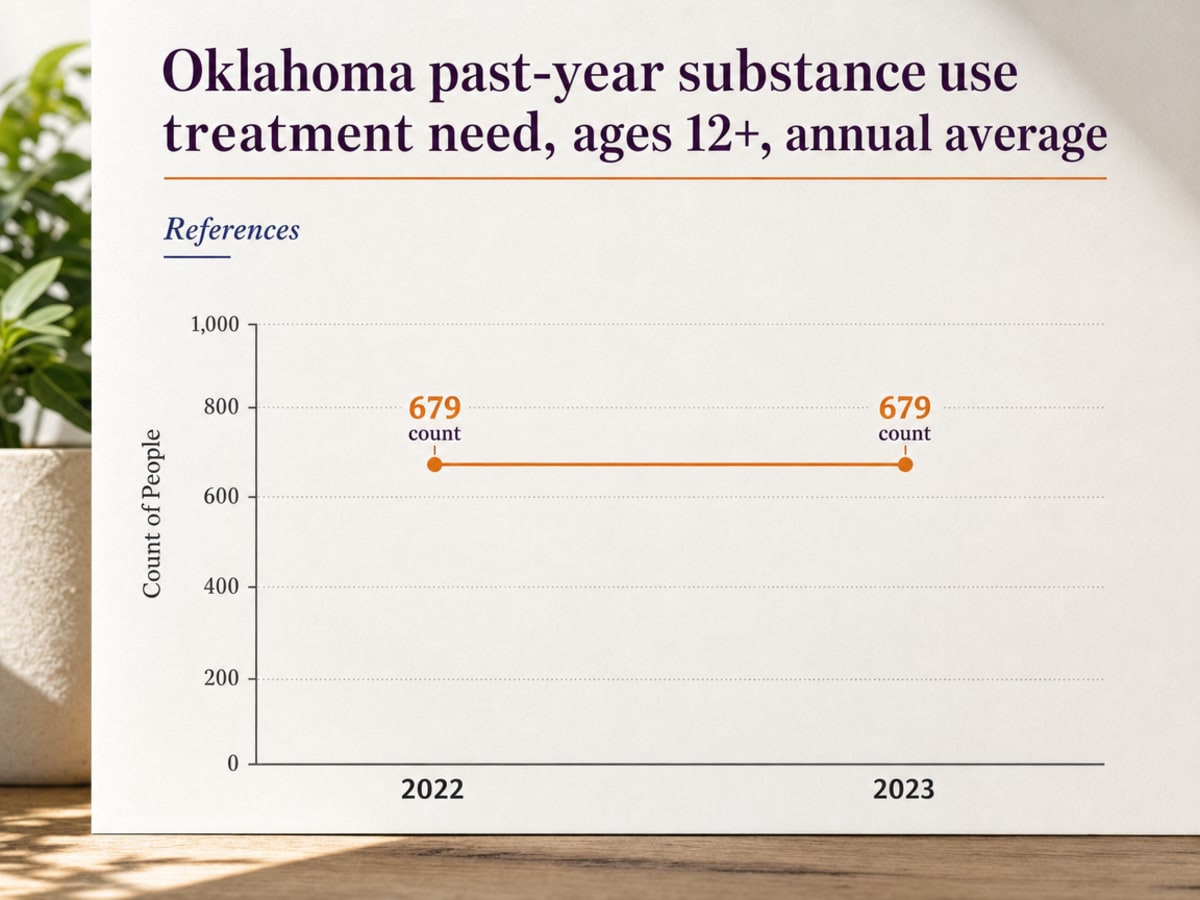
The demand for substance use disorder treatment in Oklahoma is substantial. SAMHSA’s 2022–2023 data indicates that 18.43% of Oklahomans aged 12 and older, and 19.58% of adults 18 and older, met criteria for a substance use disorder 15. Many of these individuals struggle to access specialized care.
For those in rural areas or facing long waitlists, residential programs offer a concentrated approach to care, bringing together a multidisciplinary team to bridge the gap between need and available services.
The Dangers of Mixing Benzodiazepines with Opioids or Alcohol
Combining benzodiazepines with other central nervous system depressants like opioids or alcohol significantly increases health risks. The CDC observed a 23.7% increase in benzodiazepine-involved overdose emergency department visits between April-June 2019 and the same period in 2020. This increase was even more pronounced when opioids were involved, rising by 34.4%, compared to 21.0% without opioids 10. This data underscores the amplified danger when benzodiazepines are co-administered with opioids.
Alcohol interacts with the same receptor systems as benzodiazepines, intensifying their effects and leading to a synergistic depression of the respiratory system. This combination can slow breathing to dangerous levels, a risk not typically seen with either substance alone. A comprehensive intake process should non-judgmentally inquire about all substances used, as this information is crucial for developing a safe and effective treatment plan. Transparency about co-occurring substance use allows programs to prioritize patient safety.
Benzodiazepine Tapering in Residential Care
Individualized, Gradual, and Prescriber-Led Tapering
Effective benzodiazepine tapering is a dynamic process, not a fixed schedule. It requires a prescriber to develop a plan tailored to an individual’s physiological response and adjust it as needed. The 2025 Joint Clinical Practice Guideline on Benzodiazepine Tapering emphasizes the importance of individualized, gradual tapering strategies based on patient response, rather than rigid templates 1. The initial phase of a taper often serves as a diagnostic period, observing how sleep, anxiety, and physical symptoms react to small dose reductions.
In a residential setting, these adjustments can occur rapidly. Patients are closely monitored, with vitals checked regularly, and prescribers can make informed decisions based on daily observations. SAMHSA’s treatment guidelines advocate for an integrated approach where counseling, stepped withdrawal, and education work concurrently 3. If a dose reduction proves too challenging, the plan can be slowed. If tolerated, the plan can proceed steadily. This process involves shared decision-making, ensuring the patient is an active participant in their treatment.
When Residential Care is Recommended for Complex Dependence
While not all benzodiazepine tapers require residential care, it is often recommended for complex cases. Individuals on high doses for extended periods, those mixing benzodiazepines with opioids or alcohol, or those with a history of severe withdrawal reactions may benefit significantly from inpatient management. A peer-reviewed review suggests that for severe withdrawal risk, inpatient dose tapering for two to four weeks or longer is typically advised 7. This recommendation is based on clinical risk assessment, not patient “difficulty.”
In Oklahoma, Medicaid policy utilizes the ASAM placement tool to determine the appropriate level of care. This structured assessment evaluates withdrawal risk, medical status, co-occurring conditions, and the patient’s living environment 18. Country Road Recovery Center uses this assessment to make clinical recommendations, ensuring that the level of care aligns with the patient’s specific needs to safely navigate the taper and avoid emergency situations.
Addressing Underlying Anxiety: Dual Diagnosis Treatment
Many individuals begin benzodiazepine use to manage pre-existing conditions such as panic attacks, trauma-related symptoms, or severe insomnia. If these underlying mental health issues are not addressed during the tapering process, the risk of relapse remains high, even after the medication is discontinued. Relapse often occurs not due to a lack of willpower, but because the original problem was never adequately treated. SAMHSA’s clinical guidelines explicitly state that stepped withdrawal must be integrated with counseling and education 3.
Country Road Recovery Center operates as a dual diagnosis residential program, meaning the clinical team simultaneously treats both substance use disorders and co-occurring mental health conditions. Treatment plans incorporate evidence-based therapies such as CBT and DBT for anxiety patterns, trauma-focused therapy for underlying trauma, and experiential therapies like equine and art therapy to address emotional and psychological needs. By treating the root causes alongside the physical dependence, the program aims to provide a sustainable path to recovery.
Country Road Recovery Center’s Clinical Approach
Accreditation and ASAM Placement for Quality Care
When selecting a treatment program in Oklahoma, accreditation and the method of determining the level of care are crucial indicators of quality. Country Road Recovery Center is CARF-accredited, one of the national accreditations recognized by Oklahoma’s Medicaid policy for residential SUD providers, alongside ODMHSAS state certification 17. These accreditations signify adherence to rigorous clinical protocols, staffing standards, safety measures, and effective management of complex cases like benzodiazepine withdrawal. ODMHSAS certification is also required for all SUD programs operating in the state 19. These credentials establish a baseline of quality and accountability.
The level-of-care decision at Country Road is guided by the ASAM placement tool, a requirement for residential admissions in Oklahoma 18. This assessment evaluates withdrawal risk, medical status, mental health, treatment history, and living environment to determine the most appropriate level of care, whether residential, Partial Hospitalization Program (PHP), or Intensive Outpatient Program (IOP).
The Therapeutic Environment: 136 Acres in Pink, Oklahoma
The physical environment plays a significant role in recovery. Country Road is situated on 136 acres in Pink, Oklahoma, offering a tranquil setting that promotes nervous system regulation. This peaceful environment is particularly beneficial during a taper, as it minimizes external stressors that can exacerbate rebound anxiety and sleep disturbances. The structured clinical day integrates counseling, stepped withdrawal, and education, as recommended by SAMHSA 3. This includes individual and group therapy, CBT and DBT for anxiety, trauma-focused sessions, and experiential therapies like equine and art therapy. Many staff members have personal experience with long-term recovery, providing a unique level of empathy and understanding.
Transparent Financial Planning for Treatment
Financial considerations are a legitimate part of treatment planning. Country Road works with most major insurance providers and has strong reimbursement agreements, including with Tricare East, which supports veterans and military families in Oklahoma. Before admission, the admissions team conducts a benefits check to clarify insurance coverage and any out-of-pocket expenses. This transparency ensures that patients have a clear understanding of costs upfront.
Key Questions to Ask a Treatment Program
It is important to thoroughly vet any treatment program. A program that welcomes detailed questions demonstrates transparency and commitment to patient care. Consider asking the following:
Inquire about the prescriber responsible for the taper and how frequently they will assess your progress. A gradual, individualized plan depends on close monitoring of your body’s response 1. Ask about the frequency of vital sign and symptom reviews, and how the plan adapts if a dose reduction is too rapid.
Ask how the program addresses underlying conditions such as anxiety, PTSD, or insomnia that initially led to benzodiazepine use. Effective stepped withdrawal should integrate counseling and education, not postpone it 3. Look for specific therapeutic modalities rather than vague assurances.
Finally, ask about the admissions process and if they can verify your insurance coverage immediately. Engaging in these conversations with Country Road, or any program you consider, is a crucial step toward finding appropriate care.
Start Your Safe Benzo Recovery Journey Today
Connect now to begin a safer, medically-coordinated path through benzodiazepine withdrawal and recovery.
Frequently Asked Questions
Is it dangerous to stop taking Xanax, Ativan, or Klonopin on my own?
How long does benzodiazepine withdrawal last, and what does it feel like?
The duration and intensity of withdrawal symptoms vary based on the specific benzodiazepine, dosage, and length of use. Common symptoms include sleep disturbance, anxiety, tremor, sweating, nausea, headache, and muscle pain 8. Symptoms from short-acting drugs like Xanax can appear within a day, while those from longer-acting Klonopin may be delayed and extend over weeks.
Do I need residential care, or can I taper as an outpatient?
The appropriate level of care depends on your individual risk profile. For individuals with high-dose, long-term, or polysubstance dependence, inpatient tapering for two to four weeks or longer is often recommended 7. Oklahoma utilizes the ASAM placement tool for clinical assessment 18. Country Road can conduct this assessment to determine the most suitable care level for you.
What if I started benzos for anxiety or PTSD in the first place?
It is common for benzodiazepines to be prescribed for anxiety or PTSD. If these underlying conditions are not treated concurrently, the taper may be unstable. SAMHSA’s clinical guidelines emphasize that stepped withdrawal should be integrated with counseling and education 3. As a dual diagnosis program, Country Road addresses both the substance use and co-occurring mental health conditions.
Does Country Road Recovery Center coordinate with my current prescriber?
Yes, coordination with your existing prescriber is standard practice, aligning with federal guidance on shared decision-making 2. With your consent, the clinical team can communicate with your current prescriber to review your medical history and develop a tailored tapering plan.
What should I ask when I call an Oklahoma benzo treatment program?
Ask about the prescriber who manages the taper and the frequency of patient assessments. Inquire how the plan adjusts if a dose reduction is too challenging 1. Ask about the program’s approach to treating underlying anxiety or trauma. Confirm their accreditation and ODMHSAS certification 19, and clarify insurance coverage. Clear answers indicate a transparent and reliable program.
References
- Joint Clinical Practice Guideline on Benzodiazepine Tapering. https://pmc.ncbi.nlm.nih.gov/articles/PMC12463801/
- Dear Colleague Letter: Benzodiazepine Use in Older Adults. https://www.samhsa.gov/sites/default/files/dear-colleague-letter-benzodiazepine-06052025.pdf
- Treating Substance Use Disorder in Older Adults. https://library.samhsa.gov/sites/default/files/SAMHSA_Digital_Download/PEP20-02-01-011%20PDF.pdf
- FDA requiring Boxed Warning updated to improve safe use of benzodiazepine drug class. https://www.fda.gov/media/142368/download
- RISKS FROM CONCOMITANT USE WITH OPIOIDS; ABUSE. https://www.accessdata.fda.gov/drugsatfda_docs/label/2023/013263s097lbl.pdf
- Management of benzodiazepine misuse and dependence. https://pmc.ncbi.nlm.nih.gov/articles/PMC4657308/
- Benzodiazepine dependence and its treatment with low dose flumazenil. https://pmc.ncbi.nlm.nih.gov/articles/PMC4014019/
- The benzodiazepine withdrawal syndrome. https://pubmed.ncbi.nlm.nih.gov/7841856/
- Benzodiazepine dependence. https://pubmed.ncbi.nlm.nih.gov/6145190/
- Trends in Nonfatal and Fatal Overdoses Involving Benzodiazepines, 2019–2020. https://www.cdc.gov/mmwr/volumes/70/wr/mm7034a2.htm
- Drug Overdose-Associated Hospital Encounters Involving Selected Drugs by Month from Selected Hospitals. https://www.cdc.gov/nchs/dhcs/drug-use/drug-overdose.htm
- Drug Overdose Data Dashboard – Oklahoma.gov. https://oklahoma.gov/health/health-education/injury-prevention-service/drug-overdose/data/drug-overdose-data-dashboard.html
- [PDF] Oklahoma drug overdose deaths, 2019-2023. https://digitalprairie.ok.gov/digital/api/collection/stgovpub/id/729606/download
- Oklahoma.gov. https://oklahoma.gov/content/dam/ok/en/health/health2/aem-documents/prevention-and-preparedness/injury-prevention/drug-overdose/DrugOverdoseStateFactSheet1023.pdf
- OKLAHOMA – National Survey on Drug Use and Health. https://www.samhsa.gov/data/sites/default/files/reports/rpt56188/2023-nsduh-sae-state-tables_0/2023-nsduh-sae-state-tabs-oklahoma.pdf
- Rural Health Transformation Program – Oklahoma.gov. https://oklahoma.gov/content/dam/ok/en/health/health2/aem-documents/health-promotion/rhtp/Project%20Narrative.pdf
- SECTION 95.44. Residential substance use disorder (SUD). https://oklahoma.gov/ohca/policies-and-rules/xpolicy/medical-providers-fee-for-service/individual-providers-and-specialties/inpatient-psychiatric-services/residential-substance-use-disorder-eligible-providers-and-requirements.html
- SECTION 95.46. Residential substance use disorder (SUD). https://oklahoma.gov/ohca/policies-and-rules/xpolicy/medical-providers-fee-for-service/individual-providers-and-specialties/inpatient-psychiatric-services/residential-substance-use-disorder-covered-services-and-medical-necessity-criteria.html
- Provider Certification – Oklahoma.gov. https://oklahoma.gov/odmhsas/policy/provider-certification.html