
Key Takeaways
- First responders in Oklahoma face elevated risk of PTSD and substance use disorders, with symptoms — not just exposure count — driving problem drinking.2,11
- Trauma-informed dual diagnosis care treats PTSD and substance use as one connected problem, with stabilization first and evidence-based therapies like CPT, PE, and EMDR chosen individually.11,12
- When evaluating an Oklahoma program, weigh confidentiality from command, EAP coordination, court date logistics, shift-aware re-entry planning, family involvement, and Tricare or insurance coverage.
- Oklahoma layers 988, mobile crisis teams, SB 848 peer support, and the DPS Mental Wellness Division around residential care — bring specific questions when calling to find the right fit.5,6,9
When the job stops staying at the job
You know the drive home. The radio’s off. You’re not thinking about anything, exactly, but the pediatric code from Tuesday is sitting behind your eyes, and the domestic from last month is behind that, and the driver you couldn’t get out of the car is behind that. You pull in, you don’t slam the door, you pour a drink. Then another. At some point you stopped counting, and at some point after that you stopped pretending you weren’t counting.
This is where a lot of Oklahoma first responders are right now. Not in crisis, exactly. Just carrying a load that keeps getting heavier while the tools that used to work — the workout, the buddy at the bar, the weekend off — stop touching it. NIDA is direct about it: first responders face an increased risk of substance use disorders and mental illness. That’s not a character problem. That’s a job hazard, the same way a bad back is a job hazard for anyone who lifts patients or wears 25 pounds of gear for twelve-hour shifts.4
If you’re reading this, something has already told you the drinking or the pills or the way you’re sleeping isn’t working anymore. Maybe your spouse said it. Maybe your lieutenant said it. Maybe you said it to yourself at 3 a.m. and then talked yourself out of it by breakfast.
The next few sections are for you. Or for whoever handed you this link.
Why standard rehab misses what’s actually happening
Walk into most 28-day programs and the intake looks the same for everyone. You’re asked when you started drinking, how much, whether you’ve tried to quit before. What you’re not usually asked, at least not with any depth, is what you saw the week before your use got worse. Or the year before. Or across the fifteen years you’ve been running calls.
That gap matters, because the research on responders is clear about which lever actually moves the drinking. In a peer-reviewed study of first responders, PTSD symptoms — not just the raw count of traumatic calls — were what significantly predicted alcohol and drug use. Exposure mattered, but it acted through the symptoms: the sleep you can’t get, the hypervigilance, the intrusive images, the numbness. If a program treats your drinking without treating the symptoms driving it, you are being asked to hold a beach ball underwater with one hand while it keeps trying to surface.2
The scale isn’t small, either. A meta-analytic review found that roughly 10–11% of first responders meet criteria for PTSD, and 15–25% engage in problematic alcohol use. Those two populations overlap heavily. They are not separate lanes to be treated one after the other.11
That’s the piece standard rehab often misses. Detox stabilizes your body. Twelve-step work builds a community. Neither, by itself, does anything about the pediatric call replaying at 4 a.m. or the moral injury you carry from a scene where the outcome wasn’t up to you. When trauma work is bolted on later — or, worse, never — the substance use tends to come back, because the reason for it never got touched.
What you need is a program that does both in the same room, with clinicians who understand that for a responder, the drinking is often a symptom management strategy that stopped working. That’s the case for trauma-informed dual diagnosis care, and it’s the frame everything downstream in this article is built on.
How common this actually is among people wearing the uniform
One of the quieter costs of this work is the sense that you’re the only one. You look around the truck bay or the briefing room and everyone seems fine. They’re not, and the data backs that up.
In a CDC-hosted study of first responders enrolled in a specialized behavioral health program, nearly 40% screened positive for a possible substance use disorder. Read that number carefully — these were responders who had already walked through the door of a behavioral health program, so it’s a treatment-seeking sample, not a snapshot of everyone on shift statewide. But it tells you something real: once responders are honest enough with themselves to sit down with a clinician, four in ten are already wrestling with alcohol or drugs at a level that meets clinical criteria.1
A separate study of 320 first responders sharpens the picture. In that sample, 46.88% met criteria for both alcohol misuse and probable PTSD at the same time. Not one or the other. Both, tangled together, feeding each other. Again, this was a targeted research sample, not the general responder workforce — but nearly half is not a rounding error. It is a pattern.8
What these two numbers do, side by side, is answer a question you may not have said out loud: Am I the only one on my crew who’s like this? No. You’re not. The person you nod to in the parking lot at shift change may be pouring the same drink at the same hour, telling themselves the same story about why tonight is different. The reason this matters isn’t to normalize the drinking — it’s to normalize walking into a room and asking for help. When the pattern is this common among people who do what you do, the shame that keeps you quiet has less ground to stand on.

Moral injury, shame, and the drinks you don’t count anymore
There’s a difference between being scared by something you saw and being changed by something you did, or didn’t do, or couldn’t. Fear fades. The other kind sits in your chest and rearranges the furniture. That’s moral injury — the wound that shows up when the job asks you to act, or witness, in ways that scrape against what you believe about right and wrong. The infant who didn’t make it. The call you cleared because dispatch was stacked, and the address came back an hour later. The use of force that was justified on paper and still keeps you up.
The research names this directly. In that 320-responder sample where nearly half met criteria for both alcohol misuse and probable PTSD, the group carrying both diagnoses also showed significantly higher moral injury and shame than their peers. Shame is the quiet driver here. It’s the reason you don’t tell your partner how many you had. It’s why the bottle in the truck feels safer than the conversation at the kitchen table. Shame tells you that if people knew what you’d seen — or what you feel about what you’d seen — they’d look at you differently. So you drink over it, and then you drink over the drinking.8
A program that ignores this layer will not hold you. You need clinicians who understand that the substance use is often the pressure valve on a wound the uniform doesn’t have language for yet — and who won’t flinch when you finally do find the words.
What trauma-informed dual diagnosis care actually looks like
“Trauma-informed” gets used a lot in behavioral health marketing, often to the point where it starts to mean nothing. SAMHSA’s actual definition is more useful: a program that understands how widespread trauma is, recognizes its signs, and builds knowledge of trauma into every policy and practice — not as an add-on, but as the default operating system. In practical terms, that means universal trauma screening at intake, environments designed to avoid retraumatization, staff trained to notice when a client is dysregulating, and treatment planned in phases rather than jammed into a one-size timeline.3,12,14
For you, the dual diagnosis part matters just as much. Treating the drinking without the PTSD symptoms, or the PTSD without the drinking, tends to fail on both sides. The alcohol is doing a job — knocking down the hyperarousal, blunting the images, letting you sleep for four hours instead of two — and if you take it away without giving your nervous system another way to handle those symptoms, the pressure has to go somewhere. Modern trauma-informed care builds the two tracks into the same treatment plan, sequenced carefully, with the clinician making judgment calls about what to work on and when.
The next two subsections walk through what that actually looks like on the ground: how the first stretch of treatment is designed to steady you before anyone asks about the worst call you ever ran, and which specific therapies have the research behind them for people who do what you do.
Stabilization before you touch the worst call
Good trauma treatment does not start with the worst thing that ever happened to you. It starts with sleep. With whether you can sit in a room and feel your feet on the floor. With whether your body can come down from the ceiling long enough to hear what a clinician is saying.
This is the stabilization phase, and specialized first responder programs treat it as non-negotiable. The clinical literature describes a stage-based model — assessment, stabilization, trauma-focused work, then consolidation — precisely because pushing into trauma processing before someone is regulated tends to backfire. TIP 57 makes the same point from a different angle: the goal is to understand how trauma affects your current functioning, not to force a detailed retelling of every scene.11,12
The therapies that hold up for responders: CPT, PE, EMDR
Once you are steady enough to do the work, three trauma-focused therapies have the strongest evidence base for first responders: Cognitive Processing Therapy (CPT), Prolonged Exposure (PE), and Eye Movement Desensitization and Reprocessing (EMDR). Each one goes at trauma from a different angle.11
CPT works on the beliefs that got wired in after the event — the I should have gotten there faster, the if I had been better trained, the private verdicts you handed down on yourself in the days after. You examine those thoughts on paper, with a clinician, and test whether they hold up. PE is more direct: with careful pacing, you approach the memory itself in a controlled way so your nervous system learns it is a memory, not a live threat. EMDR uses guided eye movements alongside recall to help the brain reprocess stuck material.
The research is clear that no single one of these has proven superior for responders as a group. That is why individualized planning matters. A firefighter with one defining call may do well with PE. A patrol officer carrying fifteen years of accumulated exposures and heavy self-blame may need CPT first. Your clinician should be trained in more than one, and the choice should be made with you, not handed to you.11

Country Road Recovery Center: 136 acres in Pink, Oklahoma
Pink is a small town southeast of Oklahoma City, past Shawnee, where the highway thins out and the pasture takes over. Country Road Recovery Center sits on 136 acres out there — tree line, open sky, room to breathe. For a lot of first responders, that geography does something before any clinical work starts. You are not in the city where you ran your last shift. You are not likely to run into a call sign at the gas station. The distance is part of the treatment.
Inside the program, the frame is trauma-informed dual diagnosis care, built the way SAMHSA describes it rather than the way brochures often use the phrase. Trauma screening happens at intake for everyone, not just the people who volunteer that history. The physical environment and daily structure are designed to reduce retraumatization — no surprise room searches without explanation, staff trained to notice when someone is dysregulating, and a phased approach that stabilizes you before pushing into the harder material. Your substance use and your PTSD symptoms are treated as one connected problem in one treatment plan, not handed off between departments.3,12
Care is individualized rather than tracked. A patrol officer with fifteen years and a stack of cumulative exposures does not get the same plan as a firefighter carrying one defining call, and neither gets the same plan as a dispatcher who has heard every worst moment without ever laying hands on a scene. Clinicians draw from CBT, DBT, and trauma-focused therapies, and pair that with experiential work — equine therapy, art therapy, time outside — that gives your nervous system somewhere to go when talk therapy has done what it can for the day.
The staff piece matters as much as the clinical piece. Many team members are in long-term recovery themselves. When you say you had six last night and told your partner it was two, you are not explaining that to someone reading from a textbook. Country Road is CARF accredited and works with most major insurance, including strong reimbursement through Tricare East — worth mentioning by name if you are separated military or a spouse in the family plan.
The accommodations first responders actually ask about
When responders call to ask about treatment, the questions are almost never about amenities or the swimming pool. They are about specifics that decide whether walking through the door is even possible. Can you keep this off my personnel file? What do I do about the subpoena in six weeks? Will my spouse be looped in, or shut out? Who talks to my lieutenant, and what do they say?
These are the practical hinges. A trauma-informed program that cannot answer them concretely is not really built for you, no matter what the website says. SAMHSA’s own framework points at this directly: safety and trust are not soft concepts, they are the operating requirements of any treatment setting working with heavily traumatized populations. For a first responder, safety includes knowing exactly who has access to what information, and trust includes watching a program handle the messy logistics of your life without dropping you.3
The two subsections below walk through what to actually ask about — and what a program worth your time should be able to answer without a pause.
Confidentiality from command, EAP coordination, and court dates
The first question most responders ask, out loud or not, is who finds out. Federal privacy law protects your treatment records, but the practical question is tighter than that: who at your department gets a call, when, and about what. A program that works with responders should be able to draw that line on the phone. If your EAP referred you, there is usually a limited release for attendance verification only — not clinical detail. If you self-referred, there does not have to be any contact with command at all.
Court dates and pending cases are the other snag. If you have a testimony scheduled during your residential stay, ask about supervised furlough, case management coordination with your attorney, and how the program handles temporary re-entry without derailing your treatment. Country Road includes court date assistance and communication to interested parties as standard case management functions — bring the calendar, and ask what they can hold and what they cannot.
Shift culture, re-entry, and a spouse who’s been watching this build
You do not decompress on a nine-to-five clock. If you have been running rotating shifts for a decade, your body has forgotten how to sleep at normal hours, and residential structure can feel foreign fast. Ask how the program handles sleep rebuilding, and whether the daily rhythm accommodates responders who arrive wired to nights.
Re-entry is where a lot of treatment stays fall apart. Ask about the step-down from residential to PHP or IOP, workforce reentry planning, and how the program communicates with your peer support team or EAP on the way out. The federal wellness frame calls for peer-to-peer support and normalized help-seeking as part of any real recovery infrastructure — your discharge plan should reflect that.15
And your spouse. If they have been carrying this quietly for years, they need their own seat at the table. Family education programming is not an add-on; it is where the household relearns how to talk about what happened.
Where Country Road fits in Oklahoma’s wellness ecosystem
You are not walking into this alone, and Country Road is not the only door in the state. Over the last few years, Oklahoma has built out a layered set of supports specifically for public safety personnel — and knowing how the pieces fit can make the difference between reaching for the right one at the right moment and reaching for a bottle instead.
At the acute end, there is 988 and the state’s mobile crisis system. Calling 988 connects you with a mental health professional who can loop in local resources, and ODMHSAS operates mobile crisis teams for people who need immediate help on the ground. If you are the one calling on a colleague’s behalf at 2 a.m., that is the number.6
One layer up, SB 848 directs ODMHSAS to contract for peer support crisis intervention, counseling, and wellness services for law enforcement, firefighters, EMS, and corrections personnel impacted by trauma, cumulative stress, addictions, and suicide — using ICISF-derived Critical Incident Stress Management models with qualified peer teams. That is where the person who actually understands your shift talks you through the days after a bad call.9,13
SB 1613 sits alongside that, creating a Mental Wellness Division inside the Department of Public Safety to provide ongoing mental health services and programs for public safety personnel and their families, with authorization for public–private partnerships. Dispatchers are part of this picture too — Oklahoma 911 resources point telecommunicators toward trauma-informed counseling and responder-specific peer lines. And the state’s broader first responder wellness plan calls for peer-to-peer support, normalized help-seeking, and rural agency support as core infrastructure.5,7,15
Country Road is the residential piece — the place you go when peer support and crisis calls have done what they can and the drinking is still there. The state resources handle the moments and the weeks. A trauma-informed dual diagnosis program handles the months of clinical work underneath.
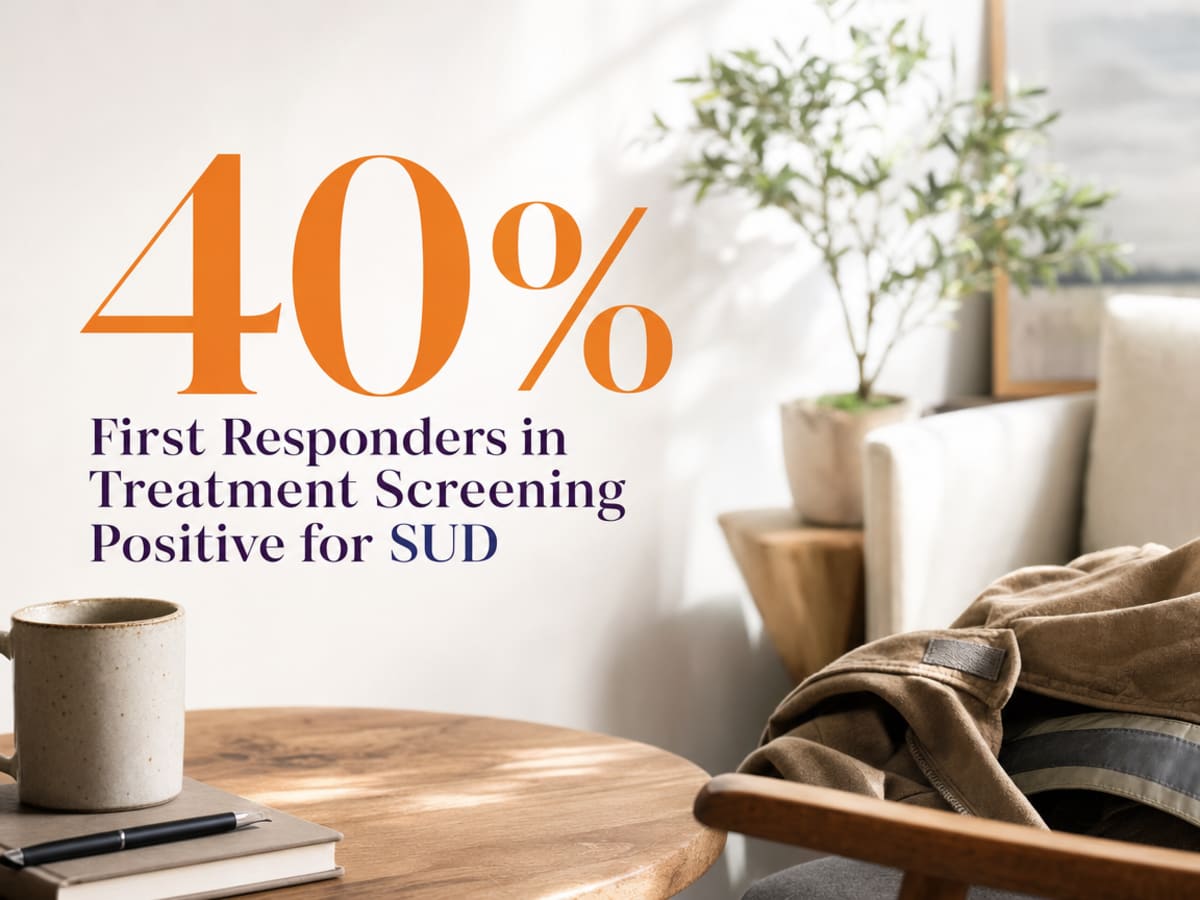

First Responders in Treatment Screening Positive for SUD
What to ask when you pick up the phone
If you get to the point of calling — you, or your spouse, or the peer support officer who has been circling this conversation for a month — bring a short list. Not because Country Road needs a test, but because the answers tell you whether a program actually fits the shape of your life.
Ask how trauma screening happens at intake, and when trauma-focused work starts relative to stabilization. Programs built around SAMHSA’s framework should be able to explain the phased approach in plain language. Ask which trauma therapies the clinicians are trained in, and whether you will have a choice between CPT, PE, and EMDR based on your history rather than the program’s default.3
Ask about confidentiality specifics: what your department gets told, what your EAP gets told, and what stays entirely between you and your clinician. Ask about court dates on the calendar, communication with your peer support team, and what family programming looks like for a spouse who has been watching this build.
Ask about insurance — including Tricare East if you carry it — and about transportation from detox if you are not steady enough to drive yourself.
Then ask the question underneath the questions: Do you understand what I do for a living? Listen to how they answer. That is the one that matters.
Start Your Confidential First Responder Intake Today
Connect now to discuss trauma-informed support tailored for first responders in Oklahoma.
Frequently Asked Questions
Will my department find out I went to treatment?
Not automatically. Your treatment records are protected by federal privacy law, and if you self-refer, there does not have to be any contact with your command at all. If your EAP made the referral, there is usually a limited release for attendance verification — not clinical detail. Ask exactly who gets called, when, and what they are told before you sign anything. A program built around trauma-informed principles treats that clarity as part of the care itself.3
Can treatment work around my shift schedule, court dates, or pending cases?
Yes, within reason. Residential care will pull you off the rotation for a stretch — that is part of how the nervous system resets — but case management can coordinate around court appearances, subpoenas, and communication with your attorney. Country Road includes court date assistance and communication to interested parties as standard functions. Bring your calendar to the intake call and ask what they can hold, what they can flex, and what genuinely cannot move.
What makes trauma-informed dual diagnosis care different from regular rehab?
Regular rehab often treats the drinking and the trauma as separate lanes, sometimes at separate facilities. Trauma-informed dual diagnosis care treats them as one connected problem in one plan. That means universal trauma screening at intake, a phased approach that stabilizes you before pushing into the hard material, and clinicians who understand that for responders, the alcohol is often doing a job the nervous system does not yet know how to do without.12
Do the clinicians actually understand first responder culture?
Fair question, and one worth asking directly on the phone. Country Road’s staff includes many team members in long-term recovery themselves, which changes the room when you sit down. Beyond that, ask which trauma therapies clinicians are trained in — CPT, PE, EMDR — and whether they have worked with law enforcement, fire, EMS, corrections, or dispatch specifically. Listen to how they answer. If they get defensive, that tells you something.11
Does insurance or Tricare cover residential treatment at Country Road?
Country Road is CARF accredited and works with most major insurance providers, with strong reimbursement through Tricare East — worth naming on the call if you are separated military, active reserve, or a spouse on the family plan. Coverage specifics depend on your policy, your deductible, and your medical necessity determination. The admissions team can run your benefits before you commit to a date, so you know what the actual out-of-pocket looks like.
What happens if my spouse or peer support team is the one calling?
That is common, and it is welcome. A spouse who has watched this build for years, or a peer support officer who has been circling the conversation with a colleague, can call to ask general questions, understand the intake process, and learn what accommodations exist. Clinical details about a specific person cannot be shared without a release, but the program can walk you through what a first responder admission looks like and how to bring it up.15
References
- Possible substance use disorders among first responders receiving treatment services in a specialized behavioral health program. https://stacks.cdc.gov/view/cdc/231205/cdc_231205_DS1.pdf
- Posttraumatic stress disorder symptoms, work-related trauma exposure, and substance use in first responders. https://pubmed.ncbi.nlm.nih.gov/35623285/
- Trauma-Informed Care in Behavioral Health Services (SAMHSA clinician guide). https://library.samhsa.gov/sites/default/files/sma15-4912.pdf
- Discipline Spotlight: Emergency Physicians and First Responders | National Institute on Drug Abuse. https://nida.nih.gov/nidamed-medical-health-professionals/discipline-specific-resources/emergency-physicians-first-responders
- Mental wellness division to be created within Department of Public Safety. https://oksenate.gov/press-releases/mental-wellness-division-be-created-within-department-public-safety
- Comprehensive Crisis Response – Oklahoma.gov. https://oklahoma.gov/odmhsas/treatment/comprehensive-crisis-response.html
- Mental Health Resources for Telecommunicators. https://oklahoma.gov/content/dam/ok/en/911/documents/telecommunicators/NPSTW-Resources.pdf
- Spirituality/Religion Among First Responders With and Without Probable PTSD and Alcohol Misuse. https://pubmed.ncbi.nlm.nih.gov/38560884/
- Bills signed to provide better mental health support to state’s law enforcement/first responders and their families. https://oksenate.gov/press-releases/bills-signed-provide-better-mental-health-support-states-law-enforcementfirst
- An analysis of suicides among first responders. https://pmc.ncbi.nlm.nih.gov/articles/PMC11284622/
- The nature of posttraumatic stress disorder in treatment-seeking first responders. https://pmc.ncbi.nlm.nih.gov/articles/PMC8794069/
- TIP 57: Trauma-Informed Care in Behavioral Health Services. https://library.samhsa.gov/product/tip-57-trauma-informed-care-in-behavioral-health-services/sma14-4816
- Peer support crisis intervention for law enforcement & first responders approved by Senate. https://oksenate.gov/press-releases/peer-support-crisis-intervention-law-enforcement-first-responders-approved-senate
- Module 4: Trauma-Informed Care – CDC Overdose Prevention. https://www.cdc.gov/overdose-prevention/php/training/module-4-trauma-informed-care.html
- First responder wellness handout – Healthy Minds. https://oksenate.gov/sites/default/files/2022-10/First-responder-wellness_handout%20Healthy%20Minds.pdf


