
Key Takeaways
- PAWS is a real symptom cluster of anxiety, sleep disturbance, anhedonia, and craving that persists well beyond 30 days and reliably predicts relapse.1
- Relapse risk stays elevated across the first year because stress and reward circuits are still recalibrating, making late cravings a biological signal rather than a motivation failure.4,11
- Trauma and PAWS stack on the same regulation system, so concurrent, integrated care outperforms the sequential model of treating substance use first and trauma later.3,8
- Focus next on treating sleep, craving, and pain as distinct clinical targets, and anchor recovery to structured aftercare with scheduled check-ins across the first year.11,14
Month Four, Still Not Sleeping: What PAWS Actually Is
It’s 3:47 a.m. again. You’ve been sober for four months, maybe five, and the same question keeps circling: if the hard part is supposed to be over, why does your body still feel like it’s running on a broken thermostat? Why does a random Tuesday afternoon flatten you? Why does the craving that hit at the grocery store yesterday feel like something you thought you were done with?
What you’re describing has a name. Post-acute withdrawal syndrome, or PAWS, is the cluster of protracted symptoms that shows up after acute detox is finished and can persist well beyond 30 days, sometimes for months. The 2022 review synthesizing the neurobiology of protracted alcohol withdrawal describes it as a real syndrome of persistent anxiety, sleep disturbance, anhedonia, and craving, and it flags those symptom clusters as reliable predictors of relapse. This is not a motivation problem. It’s a nervous system still catching up to the life you’re building.1
Here’s the piece most people don’t get told directly: PAWS matters not because it’s uncomfortable, though it is, but because it sits on top of the exact stress and reward circuits that drive relapse. When you add unresolved trauma to that mix, cravings stop being random and start acting like echoes.2,4
The rest of this article is about what’s actually happening, why the first year hits hardest, and what changes the odds in your favor.
The Relapse Window Nobody Warned You About
Why Your Brain Is Still Recalibrating Months After Detox
Here’s what most discharge paperwork doesn’t say out loud: the highest-risk stretch of your recovery starts after you leave treatment, not while you’re in it. Continuing-care research consistently shows relapse risk stays elevated across the first year of abstinence, which is precisely the window when protracted withdrawal symptoms are still active. You are not overreacting. You are living inside a documented risk period.11
The reason has less to do with willpower and more to do with what’s happening under the hood. Acute detox handles the immediate physiological crisis, but the deeper adaptations, the ones your brain made over years of use, take much longer to unwind. A 2022 neurobiology review describes protracted alcohol withdrawal as a subacute state persisting well beyond 30 days, with anxiety, sleep disturbance, anhedonia, and craving as its core features. A validation study cited in that review found that 28 PAWS symptoms clustered together with strong internal consistency and functioned as a reliable predictor of alcohol relapse. In plain terms: these symptoms are not scattered noise. They travel as a group, and that group predicts risk.1
Overlay that symptom timeline against the first-year relapse curve and the picture sharpens. Your stress and reward systems are still recalibrating during the exact months when everyday life is pushing back hardest, work stress, relationships, sleep debt, financial pressure. Making it to month four or seven with cravings still surfacing is not a treatment failure. It is your brain doing slow structural repair work while you’re already back in the world.4
The Honest Limits of What Research Knows
One thing worth saying directly, because you deserve the real picture: PAWS is not as tidy a diagnosis as the acronym suggests. The same 2022 review that maps its neurobiology also notes there is no fully standardized definition outside the benzodiazepine withdrawal literature, and the model has undergone limited systematic scrutiny compared to acute withdrawal syndromes.1
That matters for two reasons. First, if a clinician has told you PAWS “isn’t a real thing,” they are half right and half wrong. The symptom clusters are documented and predictive of relapse. The single unified definition is still being built. Second, it means your experience is data. The way anxiety, insomnia, and craving are moving through your months, that pattern is exactly what researchers are still working to formalize. Trusting what you feel, while working with people who take protracted symptoms seriously, is the honest path forward.

When PAWS and Trauma Collide
PTSD Symptoms as Craving Multipliers
If you’ve ever been blindsided by a craving that seemed to come from nowhere, take a breath. It didn’t come from nowhere. Something in the room, a smell, a voice tone, a certain kind of silence, brushed against a memory your nervous system still hasn’t finished filing away. That’s not weakness. That’s how trauma and protracted withdrawal work together.
A 2021 study on co-occurring PTSD and substance use disorders found that PTSD symptom severity is prospectively linked to craving episodes, and that intrusive memories can act as powerful craving cues with an additive effect when combined with substance-related cues. Read that again slowly. Additive. Your baseline PAWS load, anxiety, dysphoria, disrupted sleep, is already asking a lot of your regulation systems. When a trauma cue lands on top of that, you’re not dealing with one signal. You’re dealing with two, stacked.1,2
This is why cravings in month five can hit harder than cravings in week two, even though the acute withdrawal is long behind you. The PAWS symptoms create a floor of stress and low mood. The PTSD symptoms, hypervigilance, avoidance, flashbacks, spike on top of that floor. The overlap zone is where relapse risk concentrates, especially for veterans and survivors whose trauma histories were part of what drove use in the first place.9
Naming this changes what you do with it. A craving that arrives after a nightmare or a sudden reminder is not a sign your recovery is fragile. It is a sign that two documented processes just collided in your body, and both need real care.
Why Treating One Without the Other Fails
Here’s the pattern that shows up again and again in the research and, probably, in your own history: treat the substance use, leave the trauma alone, and the trauma keeps driving use back. Treat the trauma, ignore the protracted withdrawal, and the PAWS symptoms overwhelm any progress you made in therapy. A 2017 review of integrated treatment for co-occurring PTSD and SUD concluded that treating only one condition often leads to poor outcomes and relapse, because trauma symptoms continue to drive substance use while unaddressed. That is not a small footnote. That is the reason so many people cycle through treatment episodes and come out feeling like something is wrong with them.8
If your last treatment episode addressed the drinking or the pills but skipped the trauma work, that gap is not your failure. It’s a treatment design problem, and it’s one you can name and correct in your current care plan. Ask directly whether your program treats PAWS and trauma together, or hands them off to different clinicians who never talk.

The Symptoms That Independently Predict Relapse
Persistent Craving and the Erosion of Self-Efficacy
Cravings at month five are not a warning that treatment failed. They are, however, doing something quieter and more corrosive that deserves your attention: every craving that catches you off guard chips at your confidence in your own coping. That confidence has a clinical name, self-efficacy, and it turns out to be one of the mechanical parts of relapse.
Research tracking craving and self-efficacy over time found that elevated craving combined with low self-efficacy predicted worse substance use outcomes and more frequent relapse episodes. Read the two variables together. It is not craving alone that pushes people back to use. It is craving plus the growing sense that you cannot handle it. PAWS creates the perfect conditions for that erosion, because the cravings keep arriving in a body that is also tired, anxious, and slower to bounce back.13
Persistent craving also shows up as an independent predictor of relapse after alcohol use disorder treatment, alongside mood disturbances and sleep problems. The takeaway is not to fear cravings. It is to protect your sense of competence around them. Every craving you ride out without using is a small, real deposit in the self-efficacy account PAWS keeps trying to drain.12
Sleep Disturbance as a Standalone Risk Factor
If you have been treating your insomnia like a nuisance instead of a clinical problem, this is the section to slow down on. Sleep is not a wellness add-on in PAWS. It sits alongside craving, depressed mood, and anxiety as a symptom cluster that independently predicts relapse in alcohol dependence, with persistent sleep disturbance after detox associated with significantly increased relapse rates. Four horsemen, not three.14
That reframing matters because sleep is often the first thing recovery culture tells you to fix with sleep hygiene tips and a wind-down playlist. Those help, but they are not the whole picture when your PAWS-era insomnia is being driven by the same stress-system dysregulation that keeps cravings hot. Waking at 3 a.m. with your heart racing is not a bedtime routine problem. It is your protracted-withdrawal biology showing.1
The clinical implication is direct: sleep needs its own treatment target in your aftercare plan, not a footnote. That can mean:
- cognitive-behavioral therapy for insomnia,
- a medical review of any medications that fragment sleep, and
- honest conversation with your prescriber about non-addictive options.
Studies of AUD populations show that when persistent sleep problems go untreated, they hold the relapse risk elevated even when other symptoms improve. Fixing sleep is not self-care in the soft sense. It is one of the levers that moves the outcome.12,14
Chronic Pain, Somatic Distress, and the Body’s Vote
Somewhere in month three or four, a lot of people notice that their body seems to have opinions it did not have in treatment. Old injuries flare. New aches show up. Headaches, gut trouble, muscle tension that will not release. If that sounds familiar, you are not imagining it, and you are not weak for finding it hard to sit with.
Chronic pain and other negative physiological states independently raise the likelihood of relapse in people with substance use disorders, particularly when the pain is undertreated. That research overlaps directly with the somatic side of PAWS, where pain sensitivity and vague physical distress are common and can quietly wear down abstinence. Your body gets a vote in your recovery, and when it is voting loudly for relief, willpower is not the countermeasure.6
The practical move is to name pain as a treatment target rather than a background complaint. Bring it into your care plan. Ask what non-opioid pain management looks like for someone with your history, and treat the somatic layer of PAWS with the same seriousness you would treat cravings.6
Stress Reactivity and Negative Affect Across Substances
The PAWS conversation gets discussed most often in the alcohol literature, but the mechanism travels. In opioid use disorder, stress and negative affect are documented drivers of craving and relapse, with higher baseline negative affect and stress reactivity predicting worse outcomes. That is the same engine PAWS is running on, just under a different substance label.7
What that means for you: if your recovery is from opioids, stimulants, or a mixed history, do not assume the alcohol PAWS research does not apply. Depression, anxiety, irritability, and sleep disruption keep showing up as post-detox symptoms across substances, and each one loads more weight onto the stress system that is already recalibrating. A hard week at work does not just feel harder in month six. It is landing on a nervous system with less buffer.4,7
This is why stress management is not a soft skill in your relapse-prevention plan. It is a direct intervention on the mechanism that is doing the most work against you. Regular practices that reduce baseline stress reactivity, movement, therapy, structured breathing, connection, are not extras. They lower the fuel supply to the exact circuits driving craving.
What Actually Works Inside the Window
CBT and Coping-Skills Training for the Symptoms You’re Living With
You have probably done CBT before. Maybe in early treatment, maybe in an IOP group where it felt like homework. Try it on again now, because the version that helps most during PAWS is not the intake-week version. It is targeted at the exact symptoms your protracted withdrawal keeps generating.
The evidence base for cognitive-behavioral and coping-skills training in relapse prevention is built on managing high-risk situations, craving, negative affective states, and stress, which is a near-perfect overlap with the PAWS symptom cluster. Where general CBT teaches you to identify thoughts, PAWS-era CBT teaches you what to do at 3 a.m. when the anxiety spike is chemical, not cognitive. Where standard coping-skills work covers refusal scripts, this version covers riding out a two-hour craving wave when your sleep debt is already at week three.5
The concrete moves worth revisiting with your clinician:
- a written plan for your three highest-risk situations,
- a rehearsed response to intrusive craving that does not rely on distraction alone, and
- stress-management practices you actually use before you need them.
Coping skills are not a workbook. They are what your nervous system reaches for when it is overwhelmed, and that reach has to be practiced when things are calm so it is available when they are not.5
Integrated, Trauma-Informed Care Instead of Sequential Treatment
If your current care plan has one clinician for the substance use side and another for the trauma side who have never spoken to each other, you are running the sequential model in disguise. That model does not hold up in the research. The 2017 review of integrated PTSD and SUD treatment found that concurrent, trauma-focused therapies such as prolonged exposure and cognitive processing therapy, delivered alongside SUD interventions, improve outcomes and reduce relapse compared with treating one condition and hoping the other resolves on its own.8
Integrated care is not just two treatments happening at the same time in different rooms. It is a single treatment plan where the clinician tracking your cravings also knows what happened in your trauma session yesterday, and where the plan for a hard week accounts for both. That coordination is what makes the PAWS-plus-trauma load manageable instead of overwhelming.
The VA/DoD guidance is worth naming here because it applies whether you are a veteran or not. The 2021 SUD guideline and 2023 PTSD guideline recommend that evidence-based treatments for both conditions be offered concurrently, and that carrying one diagnosis should never block treatment for the other. If you have been told to “get some more time under your belt” before starting trauma work, that is worth a second conversation. Ask what “more time” specifically means, what your clinician is watching for, and whether a slower-paced trauma-focused approach is available now rather than in six months.3
The Timing Debate: Trauma Work in Early Recovery
To be honest with you: clinicians do not fully agree on when to start trauma-focused therapy in early recovery. The same integrated-treatment review that supports concurrent care also acknowledges ongoing concern among some clinicians about initiating exposure-based work while a client is still destabilized, worried it could trigger relapse rather than prevent it.8
You do not need to resolve that debate. You need to know it exists so you can be a real partner in the decision. A reasonable middle path is a stabilization phase focused on coping skills, sleep, and craving management, with trauma-focused work sequenced in as your regulation improves, rather than deferred indefinitely. “Not yet” is a legitimate clinical answer. “Not ever” is not.
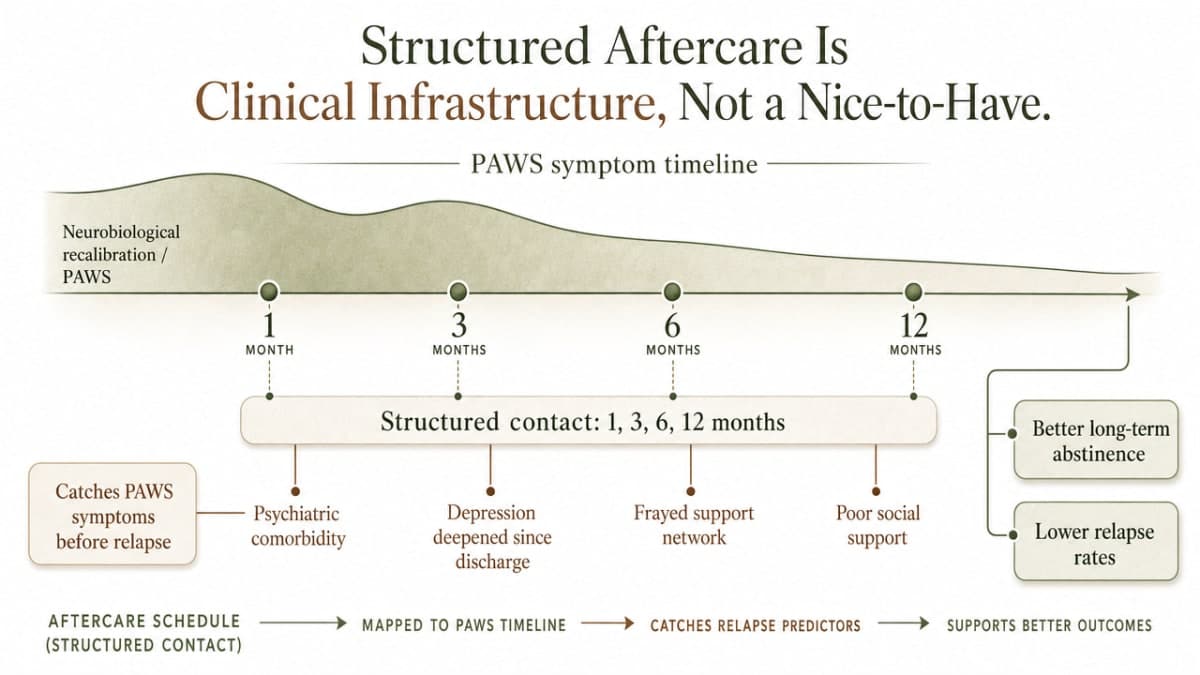

Structured Aftercare Is Clinical Infrastructure, Not a Nice-to-Have
Here is the part of your recovery that gets undersold: the check-in schedule you keep after discharge is not paperwork. It is the mechanism that catches PAWS symptoms before they compound into relapse. Extended continuing care is associated with better long-term abstinence and lower relapse rates than shorter follow-up windows, which is why structured contact at 1, 3, 6, and 12 months maps directly onto the neurobiological recalibration curve you are still living inside.11
The predictors research makes the case even sharper. After residential treatment, psychiatric comorbidity and poor social support show up as two of the strongest predictors of relapse. Both are things aftercare is built to address. A check-in at month three catches the depression that has quietly deepened since discharge. A month-six touchpoint notices that the sleep problems never resolved and gets them treated before they finish eroding your self-efficacy. An alumni network gives you people who understand why month seven can feel harder than month two, which is the social support the research keeps pointing to.10,14
Think of it this way: PAWS is a symptom load that changes shape across the year. Cravings peak differently than sleep does. Trauma cues surface on their own timeline. A single discharge appointment cannot see that curve. Scheduled check-ins can, because they intersect the timeline at the points where symptoms tend to reorganize.
If your current plan ends with “call if you need us,” that is not aftercare. That is a door. Real continuing care is a calendar, a clinician who knows your history, and a peer community you did not have to rebuild from scratch. If you are looking for that structure, Country Road Recovery’s aftercare and alumni support is designed around the timeline your brain is actually working on.
Get Support for Post-Acute Withdrawal Struggles
Connect with specialists who understand post-acute withdrawal and can help you stabilize your path to recovery.
Frequently Asked Questions
How long does post-acute withdrawal syndrome actually last?
Most people experience protracted symptoms for months, not weeks. The 2022 neurobiology review describes PAWS as a subacute state persisting well beyond 30 days, with anxiety, sleep disturbance, anhedonia, and craving clustering together as reliable relapse predictors across the first year of recovery. Your timeline is not broken. It matches the research.1
Why am I still having cravings months after I stopped using?
Because your stress and reward systems are still recalibrating. Protracted withdrawal and neuroadaptations in those circuits keep craving vulnerability elevated long after acute detox ends. In opioid recovery specifically, elevated stress reactivity and negative affect continue to drive craving episodes months in. Late cravings are a symptom of ongoing biology, not evidence of failure.4,7
Is PAWS worse if I have PTSD or unresolved trauma?
Yes, and the mechanism is specific. PTSD symptom severity is prospectively linked to craving episodes, and intrusive memories act as craving cues with an additive effect when combined with substance-related cues. Trauma exposure is also linked to more severe addiction and poorer treatment outcomes among people with SUD. Two loads stack on the same system.2,9
Should I start trauma therapy while I’m still dealing with PAWS symptoms?
Current guidance says yes, with clinical judgment. The VA/DoD recommends that evidence-based treatments for PTSD and SUD be available concurrently, and that having one disorder should not block care for the other. Some clinicians still worry about destabilization from exposure work in early recovery. A stabilization-first, trauma-focused-next sequence is a reasonable middle path.3,8
Why does my sleep still feel broken, and does it really affect relapse risk?
Sleep disturbance is a hallmark PAWS symptom driven by the same stress-system dysregulation that keeps cravings hot. It also independently predicts relapse: persistent insomnia after detox is associated with significantly higher relapse rates in alcohol dependence. Treat sleep as a clinical target with its own intervention plan, not as a wellness afterthought or sleep-hygiene checklist.1,14
What kind of aftercare actually reduces relapse during the PAWS window?
Extended, structured continuing care. Research shows longer follow-up is associated with better long-term abstinence than shorter check-in windows. Since psychiatric comorbidity and low social support are among the strongest post-residential relapse predictors, effective aftercare pairs scheduled clinical check-ins across the first year with a peer community. A calendar and a clinician who knows your history beat a hotline number.10,11
References
- Neurobiology and Symptomatology of Post-Acute Alcohol Withdrawal: A Review. https://pmc.ncbi.nlm.nih.gov/articles/PMC9798382/
- The Impact of Co-occurring Post-traumatic Stress Disorder and Substance Use Disorders on Craving and Relapse. https://pmc.ncbi.nlm.nih.gov/articles/PMC8712572/
- Treatment of Co-Occurring PTSD and Substance Use Disorders. https://www.ptsd.va.gov/professional/treat/cooccurring/tx_sud_va.asp
- Relapse in Alcohol Use Disorder: Consideration of Protracted Withdrawal and Stress. https://pmc.ncbi.nlm.nih.gov/articles/PMC4045293/
- Relapse Prevention and the Role of Cognitive-Behavioral and Coping Skills Training. https://pmc.ncbi.nlm.nih.gov/articles/PMC2928221/
- Chronic Pain, Substance Use Disorders and Risk of Relapse. https://pmc.ncbi.nlm.nih.gov/articles/PMC3860474/
- Relapse and Craving in Opioid Use Disorder: The Role of Stress and Negative Affect. https://pmc.ncbi.nlm.nih.gov/articles/PMC3721569/
- Integrated Treatment of Substance Use Disorder and Posttraumatic Stress Disorder: A Review. https://pmc.ncbi.nlm.nih.gov/articles/PMC5481205/
- Trauma Exposure and Posttraumatic Stress Disorder Among Individuals with Substance Use Disorders. https://pmc.ncbi.nlm.nih.gov/articles/PMC4387737/
- Predictors of Relapse After Residential Substance Use Treatment. https://pmc.ncbi.nlm.nih.gov/articles/PMC5146441/
- Relapse to Alcohol and Other Drugs: Relapse Prevention Strategies in Continuing Care. https://pmc.ncbi.nlm.nih.gov/articles/PMC4514331/
- Relapse After Treatment of Alcohol Use Disorder: Risk Factors and Predictors. https://pmc.ncbi.nlm.nih.gov/articles/PMC5081172/
- Craving, Self-efficacy, and Substance Use Outcomes Over Time. https://pmc.ncbi.nlm.nih.gov/articles/PMC4495609/
- Sleep Disturbance and Relapse in Alcohol Dependence. https://pmc.ncbi.nlm.nih.gov/articles/PMC4224444/


