
Key Takeaways
- Oklahoma writes separate residential standards for adults under ODMHSAS Chapter 18, requiring at least 24 treatment hours weekly, or 35 for intensive residential care.8,9
- Adult-only settings let clinicians address divorce, custody, deployment, and grief directly, while mixed-age groups must soften content to protect younger clients present in the room.
- SoonerCare covers detox, residential SUD services, outpatient care, and medication-assisted treatment for adults, with prior authorization required at higher levels of care.12
- Before committing, ask any Oklahoma program about age mix, weekly treatment hours, psychiatrist access for dual diagnosis, MAT protocols, and who handles SoonerCare authorization paperwork.
Why adult-only matters when you’re choosing rehab in Oklahoma
If you’re reading this at 2 a.m. after another rough night, or you’re a spouse who found the empty bottles again, take a breath. You’re in the right place to think this through.
Here’s the thing most Oklahoma rehab websites won’t tell you plainly: not all programs are built for the same person. Some treat teenagers and adults in the same building, sometimes in the same groups. Others are built exclusively for people 18 and older. That single design choice changes almost everything about what your day, and your recovery, actually looks like.
An adult-only program can talk directly about the things adult lives are made of — a marriage that’s cracking, a job you’re about to lose, a custody hearing next month, a deployment you never really came home from, a parent who died before you got sober. In a mixed-age room, clinicians have to protect younger clients from some of that content. In an adult room, the work can go where it needs to go.
This matters in Oklahoma specifically. Peer-reviewed research on age-specific SUD care makes the case that developmentally appropriate treatment produces better engagement, because adolescents and adults arrive with different clinical needs, different triggers, and different reasons they started using in the first place. Oklahoma’s own administrative rules recognize this too, with separate standards for adult residential treatment.8,15
The rest of this guide walks you through what Oklahoma’s adult treatment system actually looks like, what the rules require any program to deliver, how insurance and SoonerCare fit in, and the specific questions worth asking before you say yes to a bed. You’ve already done the hardest part by looking. Keep going.
What Oklahoma’s system actually looks like for adults 18+
Adults carry most of the load in Oklahoma’s behavioral health system
When people picture rehab, they often picture a young person in crisis. The numbers tell a different story. In Oklahoma’s most recent full reporting year, adults 18 and over living in a private residence accounted for 54,037 admissions to mental health services — about 61.7% of all admissions in the state. Adults are not a side population in Oklahoma’s behavioral health system. Adults are the system’s main workload.6
That matters for you in a practical way. When the majority of people walking into treatment across the state are grown adults dealing with grown-adult problems, the programs that specialize in adults 18+ are working with the population they see every day. They’re not adapting a youth curriculum for a 34-year-old parent of two. The clinical language, the group topics, the scheduling — all of it can be built around adult reality from the start.
It also means capacity is real but stretched. The FY2025 Uniform Reporting System counted only nine adult mental health programs at the URS reporting level, with about $5.1 million in adult program spending for that period. Beds fill. Waitlists happen. If someone in your life is ready today, tomorrow is not guaranteed to look the same.7
So when you call a program, you’re not asking a favor. You’re one of tens of thousands of adults in Oklahoma who use this system every year. Ask direct questions. Expect direct answers. You’re the population these programs exist for.

What adults in Oklahoma are actually being treated for
The label “substance use disorder” covers a wide range of daily lives. In Oklahoma, on a single day in 2017, 46.1% of people enrolled in substance use treatment were being treated for a drug problem only, 16.4% for an alcohol problem only, and 37.5% for both a drug and an alcohol problem. That third group — both — is where a lot of adult stories actually sit. Alcohol every night, pills on the harder nights, then a stimulant to get through the day. Programs designed for adults expect that mix and plan for it.3
You may also be reading this because someone in the family is in that 18–25 stretch. During 2017–2019, an annual average of 15.2% of young adults aged 18–25 in Oklahoma — around 64,000 people — met criteria for a past-year substance use disorder. That’s a scope figure from a national survey, not a headcount of people in treatment, but it explains why adult-focused programs pay close attention to the young-adult track: college dropouts, first DUIs, early opioid exposure, a first psychiatric hospitalization at 20.1
Adult treatment in Oklahoma isn’t one profile. It’s a working parent, a veteran, a college junior, a nurse, a retiree. What ties the room together is age and the shared work of being an adult in recovery — not the specific substance. A good adult program builds around that reality instead of forcing every story into one clinical box.

The regulatory floor: ODMHSAS Chapter 18 rules you can measure a program against
Minimum treatment hours: 24 vs. 35 hours a week
Here’s a number you can hold onto when a program’s website starts sounding the same as every other program’s website: hours per week.
Oklahoma’s Department of Mental Health and Substance Abuse Services sets a real floor for what adult residential care has to include. Under Title 450, Chapter 18, adult consumers in residential substance use treatment must participate in at least 24 treatment hours per week. In intensive residential treatment for adults, the minimum jumps to 35 hours per week. Those aren’t marketing numbers. They’re the state’s baseline for calling something adult residential care at all.8,9
What does that mean when you actually walk in the door? At 24 hours a week, you’re looking at roughly three-and-a-half hours of structured treatment per day — group therapy, individual sessions, education, skill-building — spread across morning and afternoon blocks with meals, downtime, and sleep around them. At 35 hours a week, closer to five hours a day, the schedule tightens noticeably. Group runs longer. Individual sessions come more often. There’s less unstructured time between sessions to drift.
Neither level is automatically better for you. If you’re coming off a long relapse, unstable on medication, or carrying heavy untreated trauma, the intensive 35-hour week may be what actually holds you. If you’re further along and need room to practice new coping skills, 24 hours with strong evening programming can work.
Co-occurring standards: what dual diagnosis is supposed to include
If you’ve been told before that your depression, PTSD, or anxiety would “get better once you stopped drinking,” and it didn’t — that history is telling you something real. For a lot of adults, the mental health piece and the substance use piece are woven together, and treating one without the other tends to unravel.
Oklahoma’s rules recognize this. Section 450:18-13-141 sets out what an adult residential program serving people with co-occurring substance use and mental health disorders is supposed to provide. That includes:
- a safe, welcoming, age-appropriate environment
- 24-hour structured evaluation and care
- physician and psychiatrist availability
- medication management
- case management 11
In plain terms: someone qualified to prescribe your psychiatric meds, someone tracking whether those meds are actually working, and someone helping coordinate the outside pieces of your life — probation, work, family — while you focus on treatment.
The reason this matters: the clinical literature on integrated care for co-occurring disorders consistently shows better outcomes when both conditions are treated together in the same program, by the same team, rather than handed off between separate providers.14
So when a program tells you they do dual diagnosis, ask what that actually looks like on the ground. Is there a psychiatrist on staff or on contract, and how often will you see them? Who manages your medications day to day? Does your therapist know your psychiatric history, or are you repeating your story to different people each week? The answers separate programs that market dual diagnosis from programs that deliver it.
Adult-only vs. mixed-age settings: why the group in the room changes the work
Picture two group rooms at 7 p.m.
Room one: eight adults, ages 24 to 58. A construction foreman who’s been drinking since his divorce. A nurse tapering off the pills she started taking after a back surgery. A veteran who hasn’t slept a full night since 2011. A young mom two weeks out from a DUI who lost custody. The therapist opens with grief, and nobody in the room needs the word explained.
Room two: same eight adults, plus three 16-year-olds court-ordered from a juvenile program. The therapist still wants to go to grief. But there’s a minor in the corner whose parent signed a specific consent form, and the clinical team has to think about what content is appropriate to surface in front of a kid who hasn’t lived any of it yet. The conversation softens. It has to.
Neither room is wrong. They’re just doing different work.
The developmental research is pretty direct on this. Adolescents and adults arrive at treatment with different brains, different triggers, and different reasons they started using — which is why age-appropriate programming tends to engage people better than one-size-fits-all care. A 17-year-old is often working on identity, family systems, and school reentry. A 42-year-old is working on a marriage, a mortgage, and whether their liver enzymes will come back down. Both matter. They don’t belong in the same processing group.15
An adult-only setting also changes the peer accountability piece. When the person next to you in group is another adult who’s lost jobs, buried parents, and blown up relationships, the pretending stops faster. Nobody’s performing for someone younger. Nobody’s protecting anyone from language that adults use about adult wreckage.
Oklahoma’s rules acknowledge this reality by writing adult residential standards separately from adolescent ones, with their own required hours and co-occurring provisions. That regulatory split exists because the clinical work is different work.8,11
If you’ve been in a mixed-age program before and something felt off — like you were editing yourself, or like the schedule was pitched at someone half your age — that instinct was worth trusting. It doesn’t mean you failed treatment. It means the room wasn’t built for the life you’re actually trying to rebuild.
What the evidence says about residential, dual diagnosis, and trauma-informed care
You deserve to know whether any of this actually works before you pack a bag. The honest answer: residential care isn’t the right level for everyone, and dual-diagnosis programming isn’t a marketing phrase — it’s a specific way of organizing a treatment team.
The residential literature is clear that this level of care tends to be reserved for adults with more severe substance use, complicated psychosocial situations, or a history where lower-intensity care hasn’t held. If outpatient hasn’t worked for you before, that’s not a character flaw. It’s often a sign that the level of structure was mismatched to what your nervous system and your life were actually doing.13
On the dual-diagnosis side, integrated treatment — where the same team treats your substance use and your mental health condition at the same time, in the same building, with shared notes — is associated with better outcomes than the old model of bouncing you between separate SUD and mental health providers. That research matters in practical terms: it means when you tell your therapist about a panic attack and your prescriber about last night’s craving, those two pieces of information land in the same treatment plan.14
Trauma-informed care sits inside that same integrated frame. A lot of adults arriving at Oklahoma rehabs have PTSD, complex trauma, or histories of violence and loss that predate the drinking or using by years. Programming that assumes trauma is present, rather than waiting for you to disclose it, matches how adult clinical presentations actually show up.15
What this means for you: ask what evidence base a program follows, and listen for specifics — CBT, DBT, integrated dual diagnosis, trauma-focused modalities — not just adjectives.
Medications for addiction: how adult treatment in Oklahoma has shifted
If part of what’s kept you out of rehab is the fear that you’ll be told to white-knuckle it — no medication, just willpower — that fear is outdated. Adult treatment in Oklahoma looks different than it did a decade ago, and buprenorphine is the clearest example of that shift.
On a single day in 2015, 227 Oklahomans were receiving buprenorphine as part of their substance use treatment. By 2019, that single-day count had grown to 1,140. That’s roughly a fivefold increase in four years. Behind that number is a real change in what adult programs are willing to offer: medications for opioid use disorder, prescribed and monitored inside the treatment plan instead of treated as a separate track or discouraged altogether.1
SoonerCare covers medication-assisted treatment for adults, alongside detox, residential SUD care, and outpatient services. If you have Oklahoma Medicaid, MAT is a covered benefit — not an add-on you have to fight for.12
What this means when you walk in: ask the program directly whether they prescribe or coordinate buprenorphine, naltrexone, and methadone referrals, and how they handle craving management during the first two weeks. An adult program built for 2025 realities should be able to answer that without hedging. If a program still frames medication as “trading one addiction for another,” you’re hearing an older model of care talking.
How you pay: SoonerCare, insurance, and the coverage categories that matter
Money is often the reason people wait too long. Let’s take that piece apart so it stops being a wall.
If you have SoonerCare, Oklahoma’s Medicaid program, adult substance use treatment is a covered benefit — not a favor. The Oklahoma Health Care Authority lists detox, residential SUD services, outpatient care, and medication-assisted treatment as covered for non-expansion and expansion adults, with prior authorization required for the higher levels of care. Prior auth sounds bureaucratic, and it is, but a good adult program does that paperwork for you. When you call, ask who submits the authorization and how long it usually takes.12
If you have commercial insurance — a plan through work, the marketplace, Tricare, or a spouse’s employer — most adult residential and outpatient programs in Oklahoma will run a benefits check before you commit. That call tells you your deductible, your daily or per-episode coverage, and how many days are typically authorized at each level of care. Ask for it in writing.
A few practical categories to keep straight when you’re comparing programs:8,9,12
- Detox. Medically monitored withdrawal, usually 3–7 days. Covered by SoonerCare for adults. Some residential programs run their own detox; others coordinate with a hospital or standalone detox and admit you afterward.
- Residential. The 24-hours-a-week floor set by ODMHSAS Chapter 18. Typically the longest authorization to secure.
- Intensive residential. The 35-hours-a-week track. Sometimes billed differently; ask whether your plan distinguishes the two.
- PHP and IOP. Partial hospitalization and intensive outpatient. Usually easier to authorize, often used as step-downs after residential.
- MAT. Buprenorphine, naltrexone, and methadone coordination. Covered under SoonerCare and by most commercial plans as a medical benefit.
If you’re uninsured, don’t stop reading. SoonerCare eligibility for adults expanded in 2021, and many Oklahomans who assumed they wouldn’t qualify now do. An admissions team should be able to walk you through an application the same day you call. The cost of waiting another month is almost always higher than the cost of picking up the phone.
Questions to ask any Oklahoma adult program before you commit
Admissions calls can feel like a job interview where you’re the one being sold to. Flip the script. You’re allowed to interview them. Here’s what to ask, and why each question matters.
“Do you treat adults only, or do you mix adolescents and adults in programming?” This is the first filter. If groups are mixed, ask specifically which groups and how often. An adult-only environment lets clinicians go where adult trauma and adult consequences actually live.15
“How many treatment hours per week will I have, and what fills them?” You want a number and a schedule. Anything less than 24 hours a week doesn’t meet Oklahoma’s floor for adult residential care. If you need the more intensive track, 35 hours a week is the standard.8,9
“Do you have a psychiatrist on staff or on contract, and how often will I see them?” For dual diagnosis to mean anything, someone has to manage your psychiatric medications alongside the substance use work. Ask who prescribes, who monitors, and whether your therapist sees those notes.11
“How do you handle medication-assisted treatment?” Ask whether they prescribe or coordinate buprenorphine and naltrexone, and how they manage cravings the first two weeks. A program that dismisses MAT is running an older playbook.1
“What does aftercare actually look like?” Ask about step-down to PHP or IOP, alumni contact, family programming, and case management for probation, custody, or work reentry.
“Do you handle SoonerCare prior authorization for me?” The answer should be yes, and they should tell you the typical turnaround.12
“Who are the people in my group going to be?” Age range, gender mix, veteran presence, average length of stay. You’re about to spend weeks with these people. It’s a fair question.
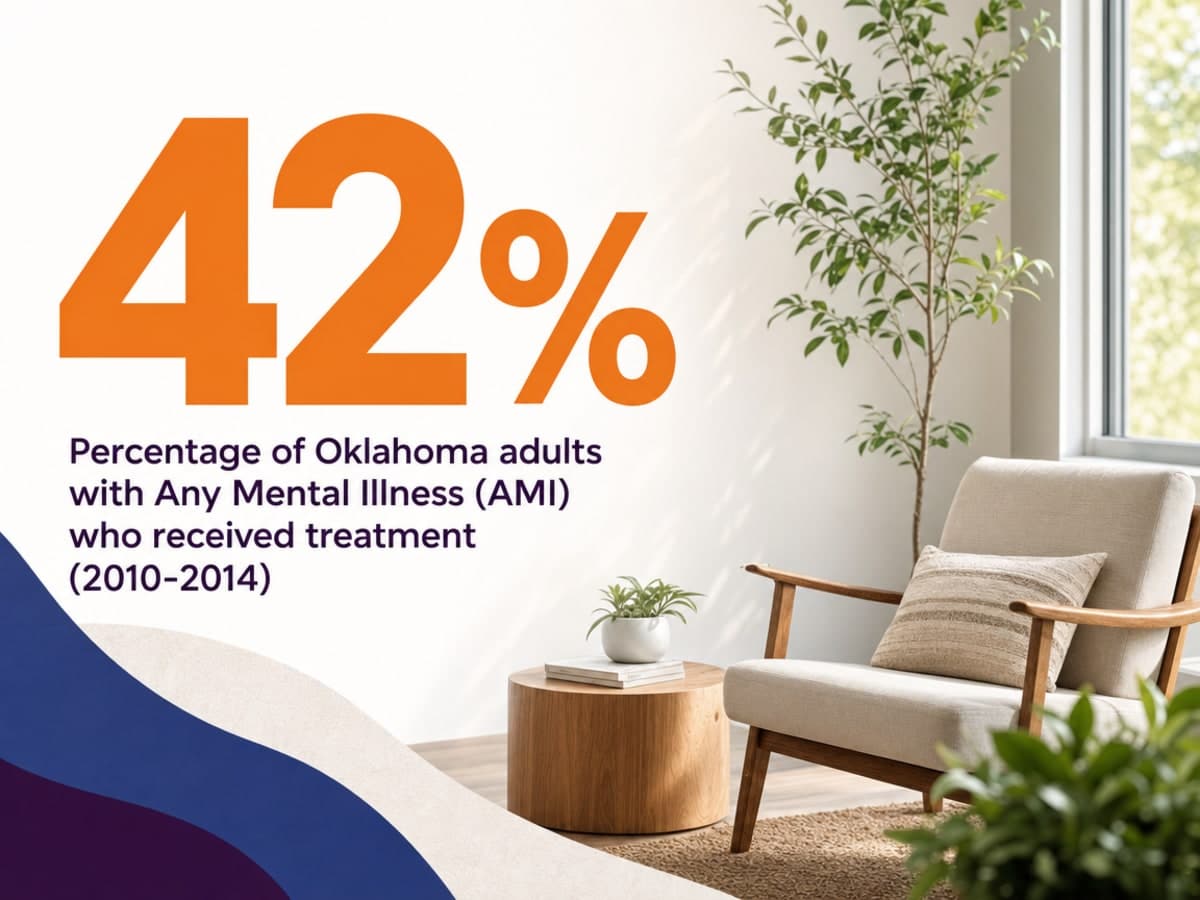

Percentage of Oklahoma adults with Any Mental Illness (AMI) who received treatment (2010-2014)
Where Country Road fits: one example of an adult-only Oklahoma program
Country Road Recovery Center sits on 136 acres in Pink, Oklahoma, about a half-hour drive from Shawnee and roughly an hour from Oklahoma City. It’s co-ed, residential, and built exclusively for adults 18 and older — no adolescent track sharing the campus, no teen groups down the hall.
That single design choice shows up in the schedule. Groups can talk directly about divorce, custody, deployment, the job you might lose, the parent you buried. Clinical programming leans on CBT, DBT, and trauma-focused therapy, with art and equine therapy in the mix, and dedicated planning for veterans. Many staff members are in long-term recovery themselves, which changes what the room sounds like at 7 p.m.
Country Road is CARF accredited, works with most major insurance including Tricare East, and offers PHP and IOP as step-downs when residential ends. Family education and an alumni community carry the work past discharge.
If you want to know exactly how the adult-only program is structured — hours per week, dual-diagnosis staffing, what your first 72 hours look like — ask them directly. That conversation is the one worth having.
Start Your Oklahoma Adult Recovery Journey Now
Connect with caring professionals ready to guide your next steps toward safe, adult-focused addiction recovery.
Frequently Asked Questions
What makes an adult-only rehab different from a general rehab in Oklahoma?
An adult-only program serves people 18 and older exclusively, so group content, schedules, and clinical language can be built around adult realities — marriage, custody, work, deployment, grief — without protecting younger clients from that material. Developmental research supports age-appropriate programming because adolescents and adults arrive with different clinical needs and triggers. Oklahoma writes adult residential standards separately for the same reason.8,15
How many treatment hours per week should an adult residential program in Oklahoma provide?
ODMHSAS Chapter 18 sets a floor of at least 24 treatment hours per week for adults in residential substance use treatment. For adult intensive residential treatment, the floor rises to at least 35 hours per week. Anything below those numbers doesn’t meet Oklahoma’s baseline for that level of care. Ask any program for a written weekly schedule that shows how those hours are filled.8,9
Does SoonerCare cover residential rehab for adults in Oklahoma?
Yes. Oklahoma Health Care Authority lists detox, residential substance use disorder services, outpatient care, and medication-assisted treatment as covered benefits for non-expansion and expansion adults, with prior authorization required for higher levels of care. Medicaid expansion in 2021 widened eligibility significantly. A good admissions team submits the prior auth for you and can start a same-day SoonerCare application if you’re currently uninsured.12
What does dual-diagnosis care actually include in an Oklahoma adult program?
Under Okla. Admin. Code § 450:18-13-141, adult residential programs treating co-occurring disorders must provide a safe, age-appropriate environment, 24-hour structured evaluation and care, physician and psychiatrist availability, medication management, and case management. The clinical literature shows integrated treatment — same team, same building, shared notes — produces better outcomes than treating substance use and mental health separately. Ask who prescribes and how often you’ll see them.11,14
Can I get medication-assisted treatment like buprenorphine during rehab in Oklahoma?
Yes, and access has grown significantly. On a single day in 2015, 227 Oklahomans were receiving buprenorphine in substance use treatment; by 2019, that count reached 1,140. SoonerCare covers MAT as a benefit alongside detox and residential care, and most commercial plans cover it as a medical benefit. Ask programs directly whether they prescribe or coordinate buprenorphine, naltrexone, and methadone referrals during your stay.1,12
What questions should I ask before choosing an adult rehab program?
Ask whether the program treats adults only or mixes ages, how many treatment hours per week you’ll get, whether a psychiatrist is on staff for dual diagnosis, how they handle MAT, what aftercare and step-down to PHP or IOP look like, and whether they submit SoonerCare prior authorization for you. If a program can’t answer specifics without hedging, that hesitation is your answer. Keep calling.11,12
References
- Behavioral Health Barometer: Oklahoma, Volume 6. https://www.samhsa.gov/data/sites/default/files/reports/rpt32853/Oklahoma-BH-Barometer_Volume6.pdf
- NSDUH Behavioral Health Barometer: Oklahoma, Volume 8. https://www.samhsa.gov/data/report/nsduh-behavioral-health-barometer-oklahoma-volume-8
- Behavioral Health Barometer: Oklahoma, Volume 5. https://www.samhsa.gov/data/sites/default/files/cbhsq-reports/Oklahoma-BH-BarometerVolume5.pdf
- Behavioral Health Barometer: Oklahoma, Volume 4. https://www.samhsa.gov/data/sites/default/files/Oklahoma_BHBarometer_Volume_4.pdf
- Behavioral Health Barometer: Oklahoma, 2015. https://www.samhsa.gov/data/sites/default/files/2015_Oklahoma_BHBarometer.pdf
- Oklahoma 2023 Uniform Reporting System Mental Health Data Results. https://www.samhsa.gov/data/sites/default/files/reports/rpt53140/Oklahoma.pdf
- Oklahoma 2025 Uniform Reporting System Mental Health Data Results. https://www.samhsa.gov/data/sites/default/files/reports/rpt57227/Oklahoma.pdf
- Title 450, Chapter 18: Standards and Criteria for Substance Related and Addictive Disorder Treatment Services (Effective 11-16-20). https://oklahoma.gov/content/dam/ok/en/odmhsas/documents/policy/provider-certification/administrative-rules/2020/AdminRules-Chapter18–11-16-20.pdf
- Title 450, Chapter 18: Standards and Criteria for Substance Related and Addictive Disorder Treatment Services (Effective 9-15-21). https://oklahoma.gov/content/dam/ok/en/odmhsas/documents/policy/provider-certification/administrative-rules/2021/Chapter%2018%20Final%20effective%209-15-21.pdf
- Title 450, Chapter 18 Proposed/Perm Rules (2022). https://oklahoma.gov/content/dam/ok/en/odmhsas/documents/policy/provider-certification/proposed-rules/2022/Chapter%2018_2022%20PERM.pdf
- Okla. Admin. Code § 450:18-13-141 – Adult residential treatment for consumers with co-occurring disorders. https://www.law.cornell.edu/regulations/oklahoma/OAC-450-18-13-141
- Mental Health and Substance Abuse Services – Oklahoma Health Care Authority. https://oklahoma.gov/ohca/individuals/programs/mental-health-and-substance-abuse-services.html
- Residential Treatment for Substance Use Disorders: Evidence and Controversies. https://www.ncbi.nlm.nih.gov/pmc/articles/PMC5758321/
- Co-occurring Addiction and Mental Health Disorders: Treatment Approaches. https://www.ncbi.nlm.nih.gov/pmc/articles/PMC2851026/
- Age-Specific Treatment Considerations in Substance Use Disorder Care. https://www.ncbi.nlm.nih.gov/pmc/articles/PMC6224580/


