
Key Takeaways
- Quitting Xanax abruptly can trigger seizures, coma, or death because alprazolam’s short half-life leaves the nervous system chemically dependent, so a supervised taper matters more than willpower.1
- Oklahoma recorded 4,812 unintentional overdose deaths between 2019 and 2023, with benzodiazepines involved in 309, making local clinical support especially relevant for metro-area residents.14
- A safe taper follows roughly 5-10% dose reductions every 2-4 weeks with clinician check-ins, and often requires treating underlying anxiety, panic, or trauma alongside the medication.3,4
- Before choosing care near Oklahoma City, compare taper protocols, dual-diagnosis and trauma-informed services, polysubstance handling, and travel logistics — Country Road sits about 40 miles from downtown off I-40.17
Why stopping Xanax on your own is the most dangerous option
If you’re reading this at 3 a.m. because you ran out of Xanax and your hands are shaking, take a breath. You are not weak. Your body has adapted to alprazolam, and what you’re feeling right now is chemistry, not character.
Quitting Xanax abruptly can trigger seizures. The FDA labeling for alprazolam lists coma, death, seizures, and difficulty breathing among the serious consequences of misuse and abrupt discontinuation in people who are physically dependent. In 2020 the FDA updated the boxed warning on the entire benzodiazepine class specifically because too many people, and too many prescribers, underestimated how hard the body pushes back when the medication stops.1,8
So when the voice in your head says, “I should just stop, I should just white-knuckle it,” that voice is wrong. Not morally wrong. Medically wrong. Peer-reviewed tapering guidance is clear that physically dependent patients should not stop suddenly and instead need a gradual, supervised reduction.2
You already know something has to change. That awareness is worth a lot. The next step is not willpower. It is getting a clinician between you and the last dose so the taper happens on a schedule your nervous system can actually survive. Country Road Recovery Center’s clinical team, about 40 miles from downtown Oklahoma City, builds those schedules every week.
What Xanax actually does to your body after regular use
The short half-life problem: why you feel worse between doses
Xanax hits fast and leaves fast. That is the whole reason it works for a panic attack, and also the reason it becomes so hard to stop.
Alprazolam calms your nervous system quickly, then clears out of your bloodstream within hours. If you take it a few times a day, your brain starts to expect that next dose. When the level drops, your body reads the drop as a threat. Your heart rate climbs. Your chest tightens. Your hands might tremble. You reach for the bottle because the pill made those feelings stop before, and it will make them stop again.
That is the loop. Not weakness. Chemistry.
Over weeks and months of regular use, your body adapts. The dose that used to take the edge off now barely holds you steady, and the gap between doses starts to feel unbearable. Some people notice they are watching the clock. Some people carry a pill in their pocket the way other people carry keys. If that sounds familiar, you are not imagining it and you are not the only one. The FDA labeling for alprazolam is direct about the risks of misuse, dependence, and addiction that come with sustained use.1
Rebound anxiety, insomnia, and the seizure risk of abrupt stopping
Here is what happens when the pill actually stops.
The anxiety you were treating comes back louder. Clinicians call this rebound anxiety, and it can feel worse than whatever sent you to Xanax in the first place. Sleep goes next. You lie awake at 4 a.m. with your mind racing, and the exhaustion the next day makes everything else harder. Your body may sweat, your stomach may turn, your muscles may ache, and irritability can spike in ways that surprise the people who love you. Deprescribing research documents all of these as expected withdrawal symptoms clinicians should be watching for at each step of a taper.5
You need to hear that plainly, because a lot of people try to quit on a Sunday, alone, and end up in an emergency room or worse. That is not a failure of resolve. It is the predictable result of asking your nervous system to do something it cannot safely do without help. The next call you make can put a clinician between you and that risk.
The Oklahoma picture: where alprazolam fits in local overdose data
National statistics can feel abstract when you’re the one holding the bottle. Local numbers hit differently.
Between 2019 and 2023, Oklahoma recorded 4,812 unintentional overdose deaths. Benzodiazepines were involved in 309 of them. Alprazolam is one of the most commonly prescribed drugs in that class, and it shows up by name in Oklahoma County’s own substance list for overdose deaths.14,16
If you live in Oklahoma City, Edmond, Norman, Moore, Midwest City, or anywhere in the metro, this is your data. Not somebody else’s. The pills passed around a friend’s kitchen, the prescription that started for a legitimate panic disorder five years ago, the bar of alprazolam bought off someone at work because the doctor cut you off — those stories are inside those 309 deaths.
What this data does not say is that everyone who takes Xanax will overdose, or that you are already too far gone. What it does say is that the risk is real enough that Oklahoma’s own health department tracks it, and that alprazolam specifically is on the county-level list clinicians in this metro pay attention to. That is the environment your recovery has to happen in, which is exactly why doing this with a supervising clinician matters more than doing it fast.16
You are not a statistic. You are a person reading this at a hard moment, in a state where the people who treat Xanax dependence have seen this pattern before and know what to do with it.

The polysubstance trap: Xanax with opioids, alcohol, or other sedatives
Most people who end up in trouble with Xanax are not taking Xanax by itself. There’s usually a drink at night to help it work faster. A pain pill left over from a surgery. A muscle relaxer a friend passed along. Maybe something bought online that was supposed to be alprazolam and probably wasn’t.
That is where the math changes.
Xanax slows your breathing. Opioids slow your breathing. Alcohol slows your breathing. When you stack them, your body can quietly stop doing the one thing it has to keep doing. The FDA made this warning the centerpiece of its 2020 boxed-warning update on the entire benzodiazepine class, calling out severe respiratory depression and death when benzodiazepines are combined with opioids or other central nervous system depressants. Alprazolam’s own labeling repeats the language: profound sedation, respiratory depression, coma, and death are possible when the two are used together. NIDA puts it in plain terms — both drug classes suppress breathing, and combining them multiplies the overdose risk rather than adding it.8,9,10
This is not a distant national worry. In 2024, Oklahoma recorded 1,207 fatal overdoses, and prescription medications contributed to 264 of them. Prescriptions — the kind that come in an amber bottle with your name on it — are still a meaningful share of who dies in this state. If your Xanax is sharing a nightstand with hydrocodone, or if you time your last bar of alprazolam to a couple of drinks, you are inside the risk group that number describes.15
You are not being lectured. You are being told, honestly, why the person on the other end of the phone at Country Road Recovery is going to ask what else is in your system before they ask anything else. SAMHSA’s guidance to clinicians is direct on this point — when Xanax use overlaps with opioids, prior overdoses, or thin psychosocial support, inpatient care is often the safer starting point rather than an outpatient taper alone. That question isn’t judgment. It’s how they keep you breathing.7
What a safe Xanax taper actually looks like
The 5–10% every 2–4 weeks standard, in plain English
If you have been on Xanax for a while, the taper is not going to be fast. That is the point.
Current clinical guidance for benzodiazepine tapering says to start low and go slow, using dose reductions of about 5% to 10% every 2 to 4 weeks, and adjusting the pace based on how you respond at each step. The joint tapering guideline behind that recommendation is even more direct about the ceiling: do not stop abruptly in physically dependent patients, use a gradual taper, and avoid reversal agents that force the drug out of your system.2,3
Here is what those percentages actually mean at the kitchen-table level. If you are taking 2 mg of alprazolam a day, a first reduction might drop you to somewhere around 1.8 mg. Not 1 mg. Not zero. A small trim, held for two to four weeks, so your nervous system has time to recalibrate before the next small trim. Then another. Then another. On paper that looks slow. In the body, it is the pace that keeps rebound anxiety, insomnia, and seizure risk from stacking up all at once.
Do the math on your own dose and you can see why residential time is not overkill. A careful taper from a moderate daily dose can easily run several months. Older adults and anyone who has been on Xanax for more than four weeks are exactly the group the deprescribing evidence base was written for. You are not being asked to suffer through this quickly. You are being asked to do it in a setting where the schedule is written down, the pill count is not on you, and someone with a license is watching how each step lands.4
That is what Country Road Recovery Center’s clinical team plans out before you ever taste the first reduction. Slow, on purpose, so your body gets to keep up.
What clinicians watch for between each dose reduction
The taper is not a math problem you solve once. It is a series of small check-ins between reductions, and the check-ins are where the real work happens.
After each step down, the deprescribing evidence base tells clinicians to watch specifically for anxiety, irritability, sweating, gastrointestinal symptoms, and insomnia. Those are the signals that your body is asking for a longer hold before the next cut. If they show up mild, the schedule usually holds. If they show up hard, the plan changes. That is not failure. That is the plan working the way it is supposed to work.5
You will be asked plain questions. How did you sleep last night. How is your appetite. Are your hands shaking more than yesterday. Are you having any twitching or muscle jerks. Is the anxiety louder than it was at the last dose. The answers get written down, and the next reduction gets scheduled — or postponed — based on what you actually reported, not on a calendar.
Shared decision-making is baked into the newer tapering guidance for a reason. You know your body. The clinician knows the pharmacology. The pace gets set together. If a reduction is too much this week, you hold. That is not going backward. That is exactly how a taper is supposed to feel when it is being done correctly.3

Treating the driver, not just the drug: dual-diagnosis care
Almost nobody starts taking Xanax for fun. You started because something hurt. Maybe it was panic attacks in the grocery store parking lot. Maybe it was insomnia that turned every 2 a.m. into a wall to climb. Maybe it was flashbacks you never told anyone about, or a grief that never quite settled, or an anxiety that has been running your life since middle school.
The pill worked. That is the part that traps you. For a while, alprazolam turned the volume down on whatever was screaming, and your brain filed that away as the solution. Now the pill is a problem too, and if a taper only removes the medication without touching what the medication was covering, the underlying condition comes back into an empty room. That is why so many careful tapers fail in the first month. Not because the person is weak. Because the driver was never addressed.
The deprescribing evidence base is honest about this limit. Its authors specifically flag that deprescribing benzodiazepines is harder, and sometimes not appropriate on its own, when untreated anxiety, depression, or other comorbidities are still driving symptoms. Translation: pulling the Xanax without treating the panic disorder underneath is setting you up to reach for it again.4
Country Road Recovery Center is built around that reality. The program is residential, dual-diagnosis, and trauma-informed, which means the taper runs alongside actual treatment for what sent you to alprazolam in the first place — CBT and DBT for panic and racing thoughts, trauma-focused therapy for what you have been carrying, equine and art therapy for the parts of you that talk before words do. Many staff members are in long-term recovery themselves, so the person sitting across from you at 7 a.m. is not guessing what this feels like.
You are not just quitting a drug. You are learning a different way to be inside your own nervous system. That takes more than a schedule of dose reductions, and it is the honest reason residential time exists. If you want to know how Country Road’s clinical team would build that plan for your specific Xanax history, that is exactly the conversation to ask for on the first call.
Inside Country Road Recovery Center in Pink, Oklahoma
The 136-acre setting and a typical day in residential care
Pink, Oklahoma is not a city. It is a small community east of Shawnee, and the 136 acres Country Road Recovery Center sits on look more like ranchland than a treatment campus. Pasture. Treeline. A pond. Horses that come to the fence when you walk over. If you have been living inside the four walls of the same apartment while your world got smaller and smaller around a pill bottle, the first thing this place does is give your eyes somewhere else to go.
A typical weekday moves in a rhythm. Morning check-in with the nursing team, where your taper dose is confirmed and you get asked the plain questions clinicians use to track how the last reduction landed — sleep, appetite, tremor, anxiety level. Breakfast with the other residents. Then group work, usually a mix of CBT and DBT skills for the racing thoughts and panic patterns that sent a lot of people to alprazolam in the first place. Individual therapy sits on the schedule too, and for people carrying trauma the sessions lean into trauma-focused work rather than skipping past it.5
Afternoons open up into experiential pieces — equine therapy in the arena, art therapy in the studio, time to walk. Evenings hold peer support, and many of the staff you’re sitting with are in long-term recovery themselves. That last part changes the room. The person handing you a coffee at 6 a.m. has stood where you are standing.
Getting to Pink from the OKC metro: I-40, I-35, and the Shawnee corridor
If you are calling from Oklahoma City, Edmond, Norman, Moore, or Midwest City, the drive is shorter than most people expect. Pink sits just off the Shawnee corridor, roughly 40 miles from downtown OKC.
From downtown or the west side, I-40 East is the straight shot — you follow it past Tinker Air Force Base and into Pottawatomie County, then drop south toward Pink. From Edmond or the north metro, I-35 South to I-40 East does the same work with one interchange. Norman and Moore residents cross east on state routes into the Shawnee area. The Oklahoma Department of Transportation city map lays out the same corridors — I-35, I-40, I-44, the John Kilpatrick Turnpike, and the Turner Turnpike — that most families end up using to get here.17
Country Road provides transportation from detox facilities and can help coordinate the ride out for people who don’t have a driver they trust. You do not have to figure out the logistics alone. When you call, the intake team will walk through how you’re getting here as part of the same conversation about your Xanax history and what the first days will look like.
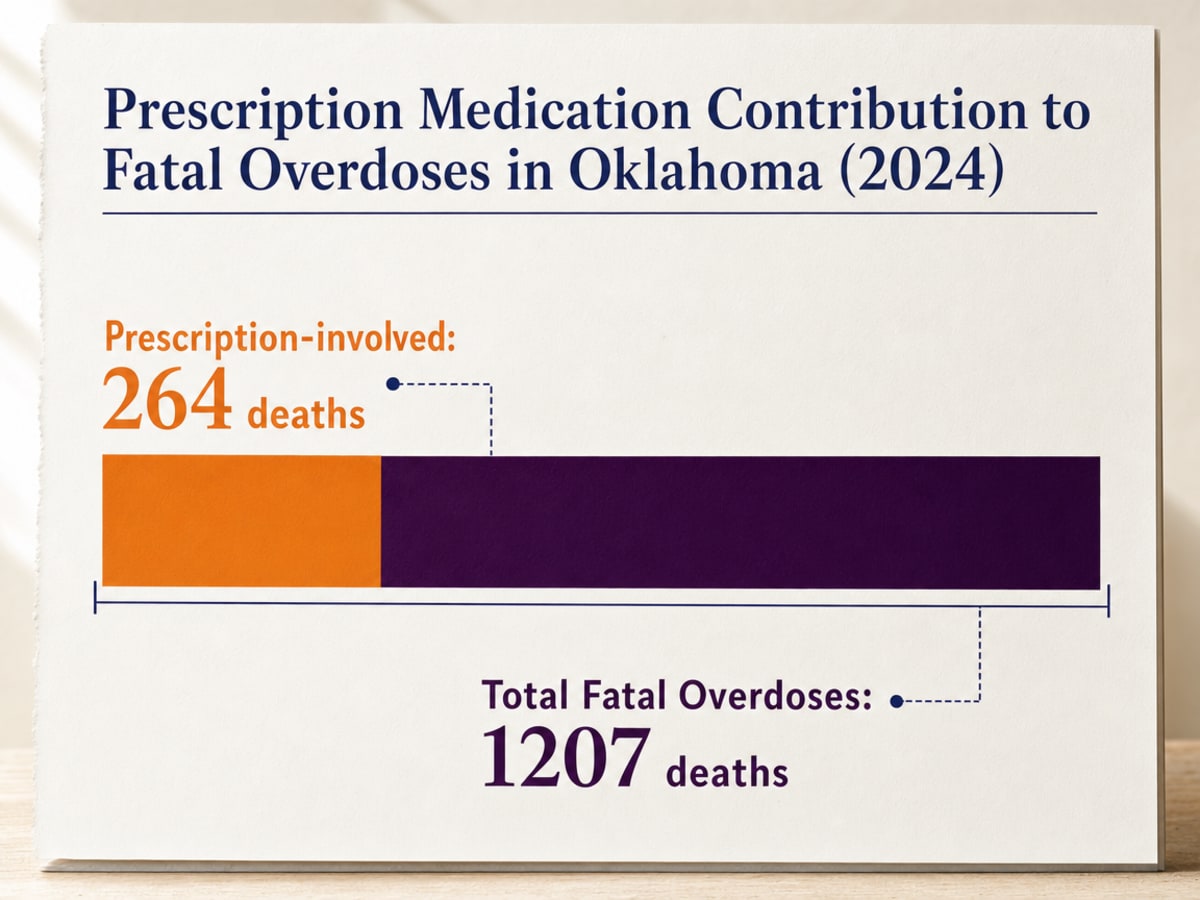

Shows the proportion of fatal overdoses involving prescription medications in Oklahoma for the year 2024.
How to make the first call without knowing what to say
You do not need a script. You do not need to have your dose written down, your insurance card in hand, or a clean version of the story ready to tell. The people who pick up the phone at Country Road Recovery Center have taken this call thousands of times, and most of those calls start the same way: a long pause, and then, “I don’t really know where to start.”
Start there. “I’ve been taking Xanax and I can’t stop” is a full sentence. So is “My daughter is on alprazolam and I’m scared.” You will not be asked to prove anything. You will be asked simple, practical things — how long you’ve been taking it, roughly how much, whether anything else is in the mix like alcohol or opioids, whether you’ve had a seizure or a bad withdrawal before. Those questions come from SAMHSA’s own assessment framework for clinicians, and they exist to gauge how much support you need, not to catch you in something.7
If you are the family member calling, that counts too. You do not need permission from the person using to ask questions on their behalf.
Ask specifically about Xanax-focused treatment planning — the taper schedule, the dual-diagnosis piece, how a first week in Pink actually goes. That’s the conversation to have. The rest gets built from there.
Start Your Xanax Recovery Journey Today
Connect with a team that understands Xanax recovery and will support your next steps.
Frequently Asked Questions
Is it dangerous to stop taking Xanax cold turkey?
Yes, and this is not a scare tactic. The FDA labeling for alprazolam lists seizures, coma, difficulty breathing, and death among the serious consequences of abrupt discontinuation in people who are physically dependent. Peer-reviewed tapering guidance says the same thing in plainer language: do not stop suddenly, use a gradual taper. If you have been taking Xanax regularly, get a clinician involved before you change your dose.1,2
How long does a safe Xanax taper actually take?
Longer than most people hope. Current clinical guidance calls for reductions of about 5% to 10% every 2 to 4 weeks, with the pace adjusted based on how you respond at each step. Do the math on a moderate daily dose and a careful taper can run several months. That is not overkill. It is the pace your nervous system needs to avoid rebound anxiety, insomnia, and seizure risk stacking up at once.3
What if I’m using Xanax with alcohol or opioids?
Say so on the first call. Mixing Xanax with opioids or alcohol raises the risk of profound sedation, respiratory depression, and death, which is why the FDA strengthened the boxed warning for the whole benzodiazepine class. SAMHSA’s own guidance is that inpatient care is often the safer starting point when benzodiazepine use overlaps with opioids, prior overdoses, or thin psychosocial support. The question is not judgment. It is triage.7,8
Will treatment address my anxiety, panic, or trauma, or just the Xanax?
Both, on purpose. The deprescribing evidence base flags that pulling a benzodiazepine without treating the anxiety, depression, or trauma underneath is often what sends people back to the pill. Country Road Recovery Center is a residential, trauma-informed, dual-diagnosis program, so your taper runs alongside CBT and DBT for panic patterns, trauma-focused therapy for what you have been carrying, and experiential work like equine and art therapy. The driver gets treated, not just the drug.4
How far is Country Road Recovery Center from Oklahoma City?
About 40 miles from downtown OKC, near Shawnee. From the west side or downtown, I-40 East is the straight shot past Tinker Air Force Base into Pottawatomie County. From Edmond or the north metro, I-35 South connects to I-40 East. The Oklahoma Department of Transportation city map shows the same corridors most families use — I-35, I-40, I-44, the John Kilpatrick Turnpike, and the Turner Turnpike. Transportation help from detox can be arranged.17
What should I say when I make the first call?
Whatever is true. “I’ve been taking Xanax and I can’t stop” is a full sentence. So is “My son is on alprazolam and I’m scared.” The intake team will ask practical questions — how long, roughly how much, what else is in your system, whether you’ve had a seizure or bad withdrawal before. Those questions come from SAMHSA’s assessment framework and exist to gauge what level of care you need, not to catch you.7
References
- XANAX® (alprazolam) tablets, USP WARNING. https://www.accessdata.fda.gov/drugsatfda_docs/label/2021/018276s058lbl.pdf
- Joint Clinical Practice Guideline on Benzodiazepine Tapering. https://pmc.ncbi.nlm.nih.gov/articles/PMC12463801/
- Supporting Patients Through Benzodiazepine Tapering. https://pmc.ncbi.nlm.nih.gov/articles/PMC12463782/
- Deprescribing benzodiazepine receptor agonists: Evidence-based clinical practice guideline. https://pubmed.ncbi.nlm.nih.gov/29760253/?tool=bestpractice.com
- Deprescribing benzodiazepine receptor agonists. https://pmc.ncbi.nlm.nih.gov/articles/PMC5951648/
- TIP 63: Medications for Opioid Use Disorder. https://library.samhsa.gov/sites/default/files/pep21-02-01-002.pdf
- Recommendations from SAMHSA (TIP 63). https://www.mass.gov/doc/recommendations-from-samhsa-re-benzo-and-bupe/download
- FDA requiring Boxed Warning updated to improve safe use of benzodiazepine drug class. https://www.fda.gov/drugs/drug-safety-and-availability/fda-requiring-boxed-warning-updated-improve-safe-use-benzodiazepine-drug-class
- Concomitant use of benzodiazepines and opioids may result …. https://www.accessdata.fda.gov/drugsatfda_docs/label/2019/018708s025lbl.pdf
- Benzodiazepines and Opioids. https://nida.nih.gov/research-topics/opioids/benzodiazepines-opioids
- Drug Overdose Deaths in the United States, 2023–2024 – CDC. https://www.cdc.gov/nchs/products/databriefs/db549.htm
- DOSE-DIS Dashboard: Nonfatal Overdose Emergency Department and Inpatient Hospitalization Discharge Data. https://www.cdc.gov/overdose-prevention/data-research/facts-stats/dose-dashboard-nonfatal-discharge-data.html
- Drug Overdose Data Dashboard – Oklahoma.gov. https://oklahoma.gov/health/health-education/injury-prevention-service/drug-overdose/data/drug-overdose-data-dashboard.html
- Drug Overdose Deaths, 2019-2023 – Oklahoma.gov. https://oklahoma.gov/content/dam/ok/en/health/health2/aem-documents/prevention-and-preparedness/injury-prevention/drug-overdose/2025%20State%20Drug%20OD%20-%20IPS%20-%20Fact%20Sheet.pdf
- Fatal Overdose Data – Oklahoma Digital Prairie. https://digitalprairie.ok.gov/digital/api/collection/stgovpub/id/728296/download
- OKLAHOMA COUNTY. https://digitalprairie.ok.gov/digital/api/collection/stgovpub/id/641307/download
- OKLAHOMA CITY. https://oklahoma.gov/content/dam/ok/en/odot/maps/city-maps/map_city_oklahoma_city.pdf


