
Key Takeaways
- Oklahoma requires ODMHSAS certification for every SUD facility, and residential programs billing SoonerCare must also hold Joint Commission, CARF, or COA accreditation.1,5
- The strongest programs share six traits: state certification, national accreditation, integrated dual diagnosis care, trauma-informed practice, individualized planning, and continuity after discharge.4
- Access is broad — 70 ODMHSAS-funded facilities reach all 77 counties — but quality varies, so location matters less than how a program answers clinical questions.8
- Call admissions with the checklist in hand, ask about certification, accreditation, dual diagnosis integration, trauma training, and week-one discharge plans, and keep calling until the answers hold up.
Why ‘best’ is the wrong question when you’re this tired
You typed “best rehab center in Oklahoma” into a search bar and hit enter. Maybe it was 2 a.m. Maybe someone you love is sleeping in the next room and you don’t know how many more mornings you can do this. Maybe you’re the one using, and you already know how the next 48 hours will go if nothing changes.
Here’s the honest thing: there is no single “best” rehab in this state. Anyone who tells you otherwise is selling something. What exists instead is a set of measurable quality signals — state certification, national accreditation, integrated dual diagnosis care, trauma-informed practice, individualized planning, and real support after discharge — that separate programs likely to help you from programs likely to cycle you back through the same door in six months.4
You’ve probably tried before. That doesn’t mean this time is hopeless. It usually means the last program didn’t fit — wrong level of care, no attention to the anxiety or trauma sitting underneath the drinking, a discharge plan that ended at the parking lot. None of that was your character failing. It was a match problem.
This guide gives you the checklist that regulators, clinicians, and researchers actually use. Read it once. Bring it to the admissions call. You get to ask hard questions. That’s not rude — that’s how you protect the person you’re trying to save.
The six quality signals that actually separate Oklahoma rehabs
Before you start comparing programs, it helps to know what you’re actually comparing. The six signals below are what regulators require, what researchers measure, and what any admissions team should be able to answer without hedging. If a program can’t clearly show you these, that’s your answer.
State certification: the ODMHSAS floor no real program skips
Every legitimate residential rehab in Oklahoma has one thing in common before anything else: it’s certified by the Oklahoma Department of Mental Health and Substance Abuse Services (ODMHSAS). This isn’t a bonus credential. State law requires it for any facility that treats substance use disorder.5
What does certification actually mean? It means the program has been reviewed against a detailed rulebook — ODMHSAS Chapter 18 — that covers how the facility is governed, who’s allowed to deliver clinical care, how assessments are done, how treatment plans get written, and how the program tracks its own quality. Chapter 18 isn’t a suggestion. It applies to every substance-related and addictive disorder treatment facility the state certifies.7
Here’s why this matters for you. When a program is certified, someone outside the program is checking the work. That’s the whole point. A staff member can’t just decide to skip your assessment because the schedule is tight. A treatment plan can’t be a photocopy with your name written in. The state’s inspection process exists to catch exactly those shortcuts.
Ask directly: “Are you ODMHSAS certified, and can you send me the current certificate?” A real program will send it that day. If the answer wanders — “we’re in process,” “we’re affiliated with,” “our director used to work there” — keep looking. Certification is the floor. Nothing else on this list matters if a program hasn’t cleared it.
National accreditation: Joint Commission, CARF, or COA
State certification proves a program follows Oklahoma’s rules. National accreditation proves it can hold up against standards written for the whole country. For residential rehab in Oklahoma, that means accreditation from one of three bodies: The Joint Commission, the Commission on Accreditation of Rehabilitation Facilities (CARF), or the Council on Accreditation (COA).1
This is not optional for programs that want to bill SoonerCare. Oklahoma’s Medicaid rules require residential providers to hold current accreditation from one of those three organizations on top of their ODMHSAS certification. The state gave programs certified before October 1, 2020 until January 1, 2022 to get accredited — and after that, no accreditation meant no reimbursement.1,6
What accreditation adds is an outside team, not connected to the state, sending surveyors into the building. They look at clinical charts. They interview staff. They watch how the program handles medication, emergencies, and complaints. It’s the closest thing to a second opinion on the program itself.
When you call, ask which body accredits the program and when the last survey happened. A CARF-accredited program, for example, should be able to name its accreditation cycle without checking. That small answer tells you whether quality is something the leadership tracks — or something they hope you won’t ask about.
Integrated dual diagnosis, not two programs stapled together
Most people entering residential rehab are not dealing with addiction alone. Depression, PTSD, anxiety, bipolar disorder — these ride alongside the drinking or the pills far more often than not. And the way a program handles that combination is one of the biggest predictors of whether treatment will actually take.
There’s a difference between a program that treats both and a program that integrates both. Integration means the same clinical team, working from the same treatment plan, addresses your substance use and your mental health at the same time. Not two intake forms. Not a psychiatrist you see once who never talks to your counselor. One team, one plan, one story about what’s happening to you.
SAMHSA’s evidence review is unambiguous on this point: integrated dual-diagnosis programs outperform programs that keep the two tracks separate. And the operational literature spells out what integration produces — reduced substance use, improvement in psychiatric symptoms and functioning, decreased hospitalization, increased housing stability, fewer arrests, and improved quality of life. Those aren’t marketing outcomes. Those are the measurable differences between someone who stays in recovery and someone who ends up back in a crisis room.2,3
NIDA reinforces the same principle from a different angle: effective addiction treatment must attend to co-occurring medical, mental, and social problems, and no single approach fits everyone. That last part matters. If a program tells you their protocol works for every client the same way, they’re describing a factory, not a treatment plan.4
What to ask: “How do you assess for mental health conditions on intake, and who on my treatment team handles both sides?” You want to hear about a single, coordinated team — a therapist, a psychiatric provider, a case manager, and often peer support — meeting together about your care. If the answer sounds like a hand-off between two departments, that’s a program that hasn’t done the integration work.
Trauma-informed practice, defined by more than a poster in the lobby
“Trauma-informed” gets printed on a lot of brochures. What it means in practice is narrower — and easier to test for than you’d think.
SAMHSA defines trauma-informed care as a strengths-based framework grounded in understanding the impact of trauma. It emphasizes physical, psychological, and emotional safety — for both the people getting care and the people providing it — and creates room for survivors to rebuild a sense of control and empowerment. Read that again. Safety. Control. Empowerment. Those are the tests.10
In a real trauma-informed program, small things look different. Staff explain procedures before they happen. You’re asked, not told, whether a door stays open. Groups are structured so people aren’t ambushed into disclosing more than they meant to share. Restraints and seclusion are rare and reviewed. Staff themselves get support, because burned-out clinicians can’t hold safe space for anyone.
The shame you may already be carrying — about how bad it got, about who you hurt, about how many times you tried before — is exactly what a trauma-informed program is built to work with, not against. If your last treatment experience felt like being scolded through a checklist, that wasn’t recovery. That was a program that didn’t understand what trauma does to a person’s ability to trust a room full of strangers.
Ask the admissions team how staff are trained on trauma, and how the program handles a client who gets triggered mid-group. The specificity of the answer will tell you whether trauma-informed is a value or a slogan.
Individualized planning and adequate duration
NIDA’s principles are direct: no single treatment is appropriate for everyone, and effective care must be tailored to the person’s drug use patterns and any co-occurring medical, mental, and social problems. That’s the standard. Anything less is a group program pretending to be a treatment plan.4
Individualized planning shows up in specific ways. Your assessment covers not just what you use, but why you started, what’s kept you using, what’s happened to your body, and what’s happening in your family, your work, and your legal life. Your plan names actual goals — not “maintain sobriety,” but “process the assault that started the drinking” or “rebuild the relationship with my kids.” Your therapies match those goals. If trauma is central, trauma work is central. If cravings are the wall you keep hitting, medication-assisted treatment is on the table.
Duration matters too. Research consistently shows that too-short stays produce too-short results. The right length isn’t a number the program picks on day one — it’s a clinical judgment updated as you move through care, with step-downs to partial hospitalization or intensive outpatient when they fit.
Ask: “How is my treatment plan different from the person who came in the day before me?” If the honest answer is “it isn’t, really,” you have your answer.
Continuity after discharge, before you ever step through the door
The most dangerous week in recovery is often the first week home. A program that treats discharge as an ending is a program that doesn’t understand the disease.
Continuity of care is a NIDA principle, not a nice extra. What it looks like in a strong Oklahoma program: a step-down pathway from residential to partial hospitalization to intensive outpatient, so intensity tapers instead of collapsing. Family education woven into treatment, so the people you’re going home to understand what recovery actually asks of them. An alumni community you can pick up the phone and call at 11 p.m. on a Tuesday. Case management that helps with housing, employment, and court dates before those become the next relapse trigger.4
You want to hear how a program handles the transition — not just whether they “offer aftercare.” Ask: “What does week one after discharge look like for me? Who calls me? What’s my next appointment, and is it already scheduled before I leave?”
If a program has thought that far ahead, it will show in how quickly they answer. If they haven’t, the silence will tell you what you need to know.

Oklahoma’s treatment landscape: broad access, uneven quality
Here’s something worth knowing before you start calling programs: you have more real choices than you probably think. The ODMHSAS-funded treatment system in Oklahoma delivers SUD services through 70 facilities that together reach all 77 counties in the state, and every SUD treatment organization operating here must be state licensed. That coverage map is unusual. In a lot of states, families in rural counties drive four or five hours for a bed. In Oklahoma, someone in every county has a program within reach.8
That’s the good news. The complicated news is that broad access is not the same thing as consistent quality. Seventy certified facilities does not mean seventy interchangeable programs. Certification proves a floor. It does not tell you which programs handle trauma well, which ones actually run integrated dual diagnosis care instead of scheduling a psychiatrist once a month, which ones build a real discharge plan, or which ones will still be answering your calls in month three.
So the question shifts. It stops being “where can I find a rehab in Oklahoma” — because that answer is almost anywhere — and starts being “which of these programs is built for what I actually need.” That’s a much more useful question, and it’s the one the checklist in the previous section is designed to answer.
The size of the network also means something else. If you call a program and the intake conversation feels rushed, dismissive, or like a script, you can hang up. There’s another certified program that will take the call. You are not stuck with the first door you knock on. That’s a small piece of power to hold onto in a moment when it may not feel like you have much.
Use the checklist. Make the calls. Compare what you hear. The programs worth your time will sound different from the ones that aren’t — and after two or three conversations, you’ll start to hear the difference clearly.
Rising demand and why standards matter more now
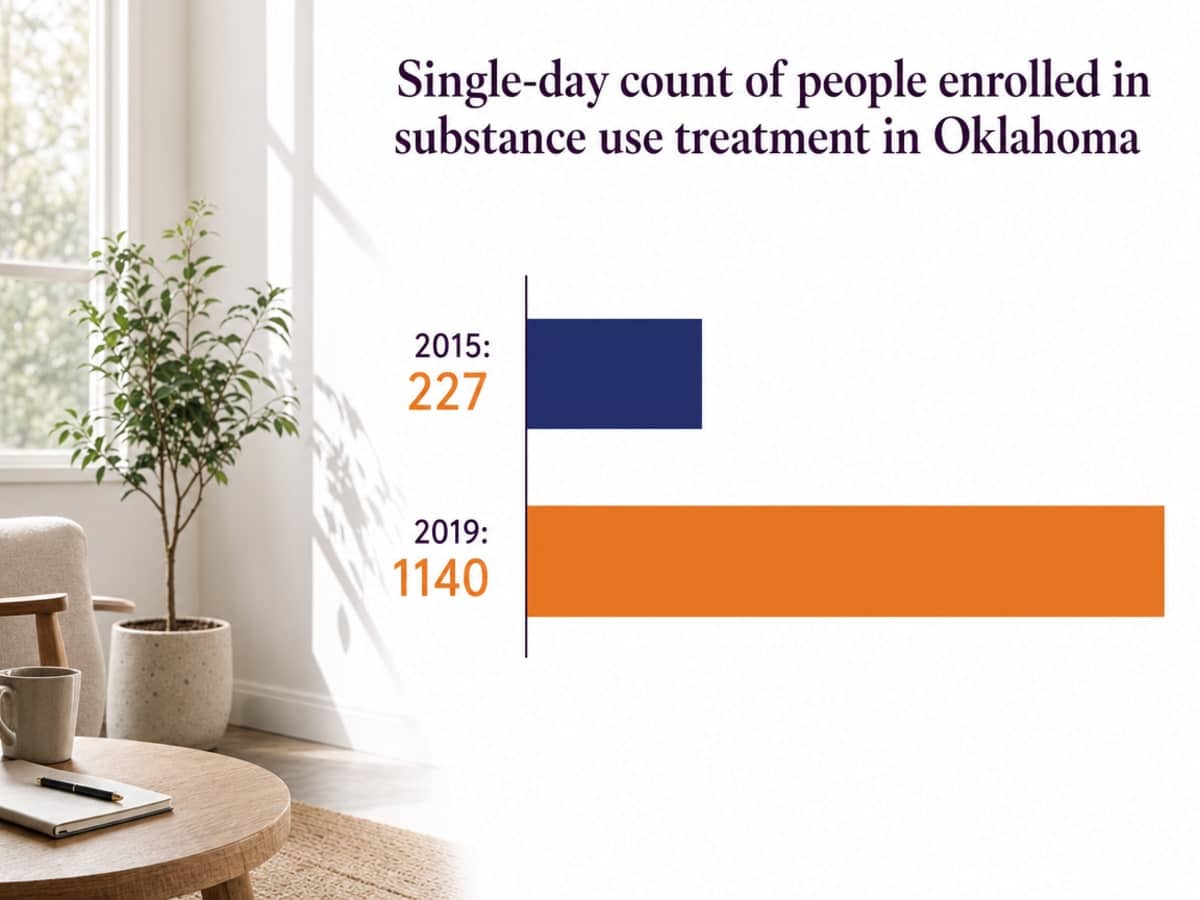
The pressure on Oklahoma’s treatment system has grown fast, and that changes what a careful search looks like. On a single day in 2015, 227 people in Oklahoma were enrolled in substance use treatment. By 2019, that same single-day count had climbed to 1,140. That’s not a slow drift. That’s a five-fold jump in four years, and it hasn’t reversed.11
When demand rises that quickly, the gap between programs widens. Well-run facilities tighten their intake process, hold onto clinical staff, and keep case management funded even when waitlists grow. Weaker programs cut corners under the same pressure — shorter assessments, thinner treatment plans, a therapist covering twice the caseload they should. Both types of program show up in your search results. Both may sound reassuring on the phone.

How Country Road Recovery Center meets the checklist
You’ve read the criteria. Here’s how one program stacks up against them — not as a sales pitch, but as a worked example of what the checklist looks like when a facility actually clears it.
Country Road Recovery Center is a co-ed residential program for adults 18 and older, set on 136 acres in Pink, Oklahoma, a rural stretch near Shawnee and about an hour from Oklahoma City. On the regulatory floor: the program holds CARF accreditation, which is one of the three national bodies Oklahoma requires for residential SUD providers seeking SoonerCare reimbursement 1. That accreditation sits on top of ODMHSAS certification — the state-required baseline for any SUD treatment organization operating here.5
On the clinical side, dual diagnosis is the specialty, not an add-on. The program is built around treating substance use alongside the mental health conditions and trauma that usually drive it — the integrated model SAMHSA identifies as more effective than siloed care. Care spans residential, partial hospitalization, and intensive outpatient, so the step-down NIDA describes as continuity of care is a built-in pathway, not a referral you have to chase.2,4
Individualized planning shows up in the mix of therapies: CBT, DBT, and trauma-focused work anchor the clinical side, while equine therapy, art therapy, meditation, and swimming give people other ways in when talk therapy alone isn’t enough. Many staff are in long-term recovery themselves, which changes how the room feels when you sit down. Family education and an active alumni community carry past discharge.
None of this makes Country Road the only program in Oklahoma worth calling. It makes it one that can answer the checklist questions without hedging — which is the bar you should hold every program to.
For veterans and their families evaluating Tricare-covered care
A note for veterans and the spouses, parents, or adult children helping them: the checklist above still applies, but a few pieces carry extra weight for you.
Trauma-informed practice is not a soft add-on when combat exposure, MST, or years of hypervigilance are part of the picture. You want a program that treats trauma as central to the clinical work — safety, control, and choice built into how groups and rooms are run. Ask directly how staff are trained to work with veterans, and whether integrated dual diagnosis care covers PTSD alongside substance use in a single treatment plan rather than two separate tracks.2,10
Confirm the coverage side plainly. Ask whether the program is in-network with Tricare, what the admissions team needs from you to verify benefits, and how quickly they can turn that around. Country Road Recovery Center works with most major insurance providers, including Tricare East, and builds individualized planning for veterans into its residential, PHP, and IOP tracks. Make the call. You’ve carried enough — this part shouldn’t be one more fight.

402.2% change. Source: https://www.samhsa.gov/data/sites/default/files/reports/rpt32853/Oklahoma-BH-Barometer_Volume6.pdf
Questions to ask on the admissions call
Print this list. Keep it next to you when you call. You don’t have to ask every question, but the ones you do ask will tell you more in ten minutes than an hour of reading a website ever will.
- Are you ODMHSAS certified, and can you email me the current certificate today? A real program answers yes and sends it.5
- Which national body accredits you — Joint Commission, CARF, or COA — and when was your last survey? Any of the three meets Oklahoma’s residential standard.1
- How do you screen for mental health conditions on intake, and does one team handle both the substance use and the psychiatric side? You want one plan, not two.2
- How are your clinical staff trained in trauma-informed care, and what happens if I get triggered in group? Specifics matter here.10
- How will my treatment plan differ from the person admitted yesterday? NIDA’s standard is individualized, not templated.4
- What does my first week after discharge look like — who calls, and is my next appointment already scheduled before I leave?
- Do you take my insurance, and how quickly can you verify benefits?
Making this call is hard. Asking these questions on top of making the call is harder. Do it anyway. The program that welcomes the questions is usually the one worth choosing.
Take the Next Step Toward Lasting Recovery
Connect with a supportive team ready to walk you through your options for safe, individualized care.
Frequently Asked Questions
Does insurance or SoonerCare cover residential rehab in Oklahoma?
Most commercial plans cover residential SUD care, and SoonerCare covers residential treatment at facilities that hold ODMHSAS certification, a contract with the Oklahoma Health Care Authority, and current national accreditation from Joint Commission, CARF, or COA 1. Ask any program to verify your benefits before admission and put the coverage details in writing so you’re not guessing about costs mid-stay.
How long should a residential rehab stay actually last?
There’s no fixed number, and that’s the point. NIDA is clear that treatment length must be tailored to the person, not the calendar, and that too-short stays produce weak results. Many people benefit from 30 to 90 days of residential care, then step down into PHP or IOP. Ask how your team decides when you’re ready to move, not just when a bed turns over.4
What should I bring, and what is not allowed at a residential program?
Every program has its own list, but the pattern is similar: comfortable clothes for two weeks, toiletries without alcohol, a photo ID, insurance card, prescribed medications in original bottles, and a small amount of cash. Leave anything with alcohol content, weapons, outside food, and non-prescribed substances at home. Ask the admissions team to email their current packing list — it changes, and you want it in writing.
Can family members visit or participate in treatment?
Yes — and a strong program builds family in on purpose. Family education helps the people you’re going home to understand what recovery actually requires of them, which is one piece of the continuity NIDA names as essential. Visit days, family therapy sessions, and structured education programming are common. Ask how family is involved in week one, week four, and after discharge, not just whether visits are allowed.4
What happens if someone has already been to rehab before and relapsed?
Relapse doesn’t mean you failed treatment — it usually means the last program didn’t match what was actually driving the use. If mental health, trauma, or family dynamics were left untouched, the pattern comes back. SAMHSA’s evidence points to integrated dual diagnosis care as more effective than treating substance use alone. Look for a program that assesses what the last stay missed and builds from there.2
Do I need medical detox before entering a residential program?
It depends on what you’re using and how much. Alcohol, benzodiazepines, and opioids often require medically supervised detox first because withdrawal can be dangerous. Many residential programs coordinate directly with detox providers and handle transportation once you’re medically stable. Call the admissions team and describe your use honestly — they’ll tell you whether detox comes first and help arrange it. That call is the hardest step.
References
- SECTION 95.44. Residential substance use disorder (SUD). https://oklahoma.gov/ohca/policies-and-rules/xpolicy/medical-providers-fee-for-service/individual-providers-and-specialties/inpatient-psychiatric-services/residential-substance-use-disorder-eligible-providers-and-requirements.html
- Integrated Treatment for Co-Occurring Disorders: The Evidence. https://library.samhsa.gov/sites/default/files/ebp-kit-the-evidence-10242019.pdf
- Integrated Treatment for Co-Occurring Disorders: Building Your Program. https://library.samhsa.gov/sites/default/files/ebp-kit-building-your-program-10112019.pdf
- Principles of Drug Addiction Treatment: A Research-Based Guide (Third Edition). https://nida.nih.gov/publications/principles-drug-addiction-treatment-research-based-guide-third-edition
- Provider Certification – Oklahoma.gov. https://oklahoma.gov/odmhsas/policy/provider-certification.html
- Okla. Admin. Code § 317:30-5-95.44 – Residential substance use disorder treatment services. https://www.law.cornell.edu/regulations/oklahoma/OAC-317-30-5-95.44
- Chapter 18. Standards and criteria for substance-related and addictive disorder treatment facilities and organizations. https://oklahoma.gov/content/dam/ok/en/odmhsas/documents/policy/provider-certification/administrative-rules/2021/Chapter%2018%20Final%20effective%209-15-21.pdf
- 2023 Oklahoma State Report: Underage Drinking Prevention and Enforcement. https://library.samhsa.gov/sites/default/files/oklahoma-iccpud-state-report-2023.pdf
- OKLAHOMA – 2022 NSDUH State Estimates. https://www.samhsa.gov/data/sites/default/files/reports/rpt44486/2022-nsduh-sae-state-tables/NSDUHsaeOklahoma2022.pdf
- Trauma-Informed Care in Behavioral Health Services: Literature Review (Part 3). https://library.samhsa.gov/sites/default/files/sma14-4816_litreview.pdf
- Behavioral Health Barometer: Oklahoma, Volume 6. https://www.samhsa.gov/data/sites/default/files/reports/rpt32853/Oklahoma-BH-Barometer_Volume6.pdf


