
Key Takeaways
- Federal protections stack in your favor: 42 CFR Part 2 shields treatment records, the ADA keeps medical files separate, and FMLA covers up to 12 weeks of job-protected leave for treatment.13,20,14
- Licensed clinicians should learn their pathway before a crisis: Physician Health Programs and state nurse intervention programs offer voluntary, confidential monitoring, with 78.7% of physicians licensed and working at five years.9,12
- Intensive outpatient care is built around working schedules, with three-to-five sessions weekly in early-morning or evening blocks that FMLA can certify as intermittent leave.21
- Plan for year one deliberately: 33.9% of return-to-use episodes happen in the first year, but by year five 81.4% complete monitoring and 55.9% are back to full-time clinical work.16
The Fear That Keeps You From Calling
You have probably rehearsed the call a dozen times and hung up before dialing. Not because you doubt you need help, but because you can picture what happens next: the licensing board letter, the credentialing questionnaire, the partner meeting where someone you trained looks at you differently.
That fear is rational. It is also not the whole picture.
What you are actually weighing is a specific stack of protections most articles skip over. Federal law shields your treatment records from casual disclosure. The ADA requires your employer to keep medical information in a separate, confidential file. FMLA gives you job-protected, unpaid leave for treatment provided by a health care provider. If you hold a clinical license, your state likely has a voluntary, confidential monitoring pathway designed to keep you working, not to end your career.12,13,14,20
None of this makes the phone call easy. It does mean the call is not the reckless act it feels like at 2 a.m.
The rest of this guide walks the decision in the order you actually face it: legal protection first, program structure second, monitoring and data third, then returning to work. You do not have to hide. You have to choose a program that already understands your license.
The Legal Architecture That Protects Your Records and Your Job
42 CFR Part 2, HIPAA, and What Actually Stays Private
Your treatment records are not ordinary medical records. They sit inside a separate federal regulation that predates HIPAA and, in several ways, protects you more tightly.
42 CFR Part 2 governs the confidentiality of substance use disorder patient records at federally assisted programs. The rule requires programs to tell you at admission that federal law protects your records, and it restricts disclosure in civil, criminal, administrative, and legislative proceedings unless a narrow exception applies. This means your therapist cannot confirm you are a patient to a curious colleague, a subpoena in a custody dispute, or a licensing investigator without your written consent or a specific court order.13
HIPAA sits underneath Part 2 as the broader baseline for protected health information. Recent updates align Part 2 more closely with HIPAA to make care coordination easier, while keeping the heightened protections for SUD information intact.13
What this means for you: the intake clinician cannot call your hospital, your firm, or your board. Insurance billing runs through coded claims, not narrative notes. If someone wants to verify your treatment status, they need your signature on a specific, revocable release naming the recipient and the purpose. You control what leaves the file.
ADA Confidential Medical Files and FMLA Job-Protected Leave
Two federal employment laws provide crucial protections that many professionals are unaware of.
The Americans with Disabilities Act treats information about your medical condition or history as a confidential record that must be kept on separate forms in separate medical files, not in your personnel folder. Your manager does not get to read it. Your peers do not get to hear about it in a staff meeting. If you are in recovery and no longer using illegal drugs, the ADA also frames you as a person who may be entitled to reasonable accommodation, such as a modified schedule to attend outpatient sessions. 20
The Family and Medical Leave Act gives you up to 12 weeks of unpaid, job-protected leave for a serious health condition, and Department of Labor guidance is explicit that treatment for substance abuse by a health care provider qualifies. Your employer must keep the medical certification confidential and separate from your personnel file. They also may not retaliate against you for using FMLA leave for treatment.14,21
State Law as a Second Shield: Oklahoma Title 43A as an Example
Federal law sets the floor. State law often stacks on top.
Oklahoma’s Title 43A is a useful example because it is direct. The statute treats all mental health and drug or alcohol abuse treatment information, along with the identity of anyone receiving those services, as privileged and confidential under state law. That is a second, independent legal barrier between your treatment file and anyone asking about it.17
Whatever state you practice in, ask two questions before you enroll: Does state law add confidentiality protection beyond Part 2? And what, specifically, triggers a mandatory report to your licensing board? The answers shape everything that follows.
Licensure-Board Pathways: PHPs, Nurse Intervention Programs, and Everyone Else
Physician Health Programs: Voluntary, Confidential, and Structured
If you hold a medical license, a Physician Health Program is probably the single most important piece of vocabulary you need to learn this week.
A PHP is not a disciplinary body. It is a confidential, non-punitive alternative that offers evaluation, treatment referral, and long-term monitoring outside the licensing board’s public discipline track. Participants who enter voluntarily and stay compliant are generally shielded from board action, and organized medicine has actively advocated for rules that protect the confidentiality of fully compliant participants when they answer licensing and credentialing questions.18
The structure is real, though. A PHP contract typically includes random drug testing, workplace monitoring, mandated abstinence, and regular check-ins over several years. Physicians who completed these programs described the components as acceptable and helpful, with benefits sustained across a five-year window.8
The long-horizon numbers explain why so many state medical societies point their members here first. In a landmark cohort of 802 physicians treated through PHPs, 631 (78.7%) were licensed without restriction and working at five years, and among those who completed monitoring, 95% were licensed and working as physicians.9
Read that carefully. Entering a PHP does not end your career. Refusing evaluation when a colleague, hospital, or board already has concerns is far more likely to.

Nurse Intervention Programs and the Culture of Silence
Nursing has its own version of intervention programs, partly due to the historically challenging culture surrounding substance use among nurses.
A widely cited analysis of substance use among nurses describes a don’t ask, don’t tell
environment where colleagues suspect, look away, and the affected nurse suffers in isolation until something catastrophic forces disclosure. The authors advocate for confidential reporting channels, respect, and treating addiction as a medical disorder rather than a moral failing.19
State intervention programs are the structural answer. California’s Board of Registered Nursing describes its Intervention Program as a voluntary and confidential monitoring program that connects RNs whose competency may be impaired by SUD or mental illness with effective treatment, an individualized recovery plan, and a monitored return to safe practice. Most states run something comparable under a different name.12
What that means for you as a nurse: entering the program before an incident, a diversion allegation, or a positive workplace screen usually preserves the voluntary track. The door narrows once the board is already looking. If you are reading this at 11 p.m. after a rough shift, the call you can make tomorrow is to your state’s intervention program intake line, not your nurse manager.
If You Don’t Hold a Clinical License: ADA/FMLA as Your Pathway
Attorneys, executives, engineers, pilots, teachers, and countless other professionals do not have a PHP-style program waiting for them. That does not leave you without a pathway.
Your federal protections are the ADA and FMLA, working together. The ADA covers people with a history of substance use disorder who are no longer currently using illegal drugs, and it requires your employer to hold medical information in separate confidential files, not your personnel folder. It can also require reasonable accommodations, such as a schedule that allows evening outpatient sessions. FMLA layers on up to 12 weeks of unpaid, job-protected leave for treatment by a health care provider, with medical records kept confidential.20,21
Some professions have their own reporting rules, most notably aviation and certain safety-sensitive federal roles. Check yours before you enroll, not after. For most private-sector professionals, though, the practical sequence is: request FMLA for treatment, provide only the certification your employer is entitled to, and let the outpatient program communicate through signed, purpose-limited releases.
Licensure-Pathway Comparison at a Glance
Here is how the three pathways actually differ on the questions you are asking at midnight.12,14,18,20,21
| Pathway | Confidentiality Structure | What Triggers a Board Report | Typical Monitoring Duration |
|---|---|---|---|
| Physician Health Program (PHP) | Voluntary, confidential; compliant participants generally shielded from board discipline | Refusal to follow recommendations, non-compliance, or safety risk | Typically 5 years; components sustained across that window |
| State Nurse Intervention Program (e.g., California BRN) | Voluntary and confidential monitoring with an individualized recovery plan | Non-participation or failure to meet plan terms; state statutes vary | Multi-year, tied to safe-practice return plan |
| Employed Non-Licensed Professional (ADA/FMLA) | Medical files kept separate and confidential by employer under ADA; FMLA certifications kept confidential | No licensing board involved unless a separate credential applies; employer action limited by ADA and FMLA anti-retaliation rules | Determined by treatment plan and any employer accommodation, not a statutory program |
One takeaway to carry into the next section: whichever row describes you, the pathway assumes you engaged with treatment before the crisis. Which is what an intensive outpatient program is built to make possible.
How Intensive Outpatient Care Fits a Working Schedule
The reason intensive outpatient care exists is you. Someone with a full calendar, a mortgage, and a role that cannot simply disappear for 90 days without questions.
A typical IOP runs three to five days a week, three hours per session, most often in early-morning or evening blocks. That schedule is not a compromise. It is the clinical model. You attend group therapy, individual counseling, and psychoeducation in a structured block, then go back to your life to practice what you learned in the environment that actually challenges you.
For your workday, this usually looks like: sessions before rounds, sessions after the last deposition of the day, or a compressed Tuesday-Thursday-Saturday cadence. FMLA can cover the intermittent hours if your provider certifies them, and your employer must keep that certification confidential and separate from your personnel file. The ADA framework supports requesting a modified schedule as a reasonable accommodation for treatment attendance.20,21
Two logistical points matter more than most people realize. First, transportation and childcare during those specific session hours will be the friction that trips you up in week two, not the therapy itself. Solve them before day one. Second, ask the program directly how they coordinate with a PHP or state intervention program if you are enrolled in one, because clinical notes, attendance verification, and toxicology results move through signed, purpose-limited releases you control.13
Showing up for the first assessment is the hardest logistical step. Everything after that is a schedule you can actually keep.
Biometric and Data-Driven Monitoring: Promise, Limits, Honest Reading
You are an analytical person. So let’s be analytical about what a wearable can and cannot do for your recovery.
The affirmative case is real and getting stronger. A 2023 study using wearables and an ecological momentary assessment app on smartphones showed that physiological and self-report data can help predict near-term drug use recurrence, opening the door to interventions delivered before use happens rather than after. Feasibility studies of biosensors consistently find that participants view the devices as acceptable and not disruptive to daily life, which matters when your life is already crowded.1,7
A broader 2025 scoping review of wearable-based continuous monitoring found that four of six randomized trials (67%) showed a positive clinical impact and that most observational studies identified significant correlations between device data and clinical outcomes. Systematic reviews of wearables in SUD care similarly report that these devices can help reduce heavy substance use and monitor overdose risk.3,4
Here is the honest counterweight. A 2022 systematic review concluded that current evidence is insufficient to support routine remote monitoring of non-alcohol, non-nicotine SUDs through wearables as a standalone tool. Additionally, a review of biosensors in alcohol use disorder treatment noted that clinicians in several studies were not given access to real-time data, so the potential of continuous signals often went unused inside actual care.2,6
The practical read for you: a wrist-worn device that tracks sleep, resting heart rate, and stress patterns can make your recovery visible to your clinician between sessions and give you an early nudge when your physiology drifts before your behavior does. It is not a replacement for therapy, medication, or the human accountability of a monitoring contract. Ask any program you consider one question: who actually looks at the data, and what do they do with it on a Tuesday afternoon?
Outcomes You Can Plan Around, Including the Hard Year
You want to know the odds. Not the marketing version. The actual number.
Here is the anchor. A 2021 meta-analysis pooling data from monitoring programs for healthcare professionals with substance use disorder found a 72% success rate for abstinence and a 77% success rate for work retention at follow-up. That is a synthesis of multiple studies of licensed healthcare workers enrolled in structured monitoring, not a promise for every person or every profession, but it is the closest thing to a defensible baseline you will find.11
Read it alongside a candid counterweight. A more recent long-horizon study of healthcare professionals in monitoring reported that return to use occurred in 48.6% of participants, with the highest incidence, 33.9%, in year one. By year five, 81.4% had completed monitoring and 55.9% were working full-time in healthcare.16
Plan for the year-one risk explicitly. Front-load your therapy hours, build the sober support you can actually text at 9 p.m., and treat the first twelve months as the period where the monitoring contract earns its keep, not the period you white-knuckle alone.

Returning to Work Without Losing What You Rebuilt
The moment you have been rehearsing since day one is not the intake call. It is the first shift back, the first client meeting, the first case where someone hands you a chart and expects the version of you that existed before all this.
That transition is where structured monitoring earns its reputation. It gives you a defensible answer when a credentialing committee asks how they can trust your judgment: you can point to a documented contract, negative toxicology results, and a treating clinician who signs off on fitness for duty. Physicians who complete PHP monitoring show sustained results across a five-year window, with the components of monitoring viewed as helpful rather than punitive by those who finished. Narrative synthesis across studies finds that physicians completing their PHP contracts have more favorable treatment outcomes than the general population receiving mainstream treatment. Your continued employment is not a favor. It is the outcome the program was built to produce.8,10
Practical reentry has three moving parts you can plan now. Coordinate your return-to-work letter with your treating provider and your monitoring program before your first day back, so scope-of-practice questions are answered in writing, not in a hallway. Keep your toxicology schedule inviolate. Missed tests read worse than positive ones. And treat any peer or supervisor who has to be informed as a defined recipient under a signed release, not a general audience.13
You will also feel the year-one weight even as you look competent to everyone else. Front-load your therapy in the first six months back, not the last. That is where the monitoring contract is doing its heaviest lifting, and it is where the career you rebuilt stays intact.
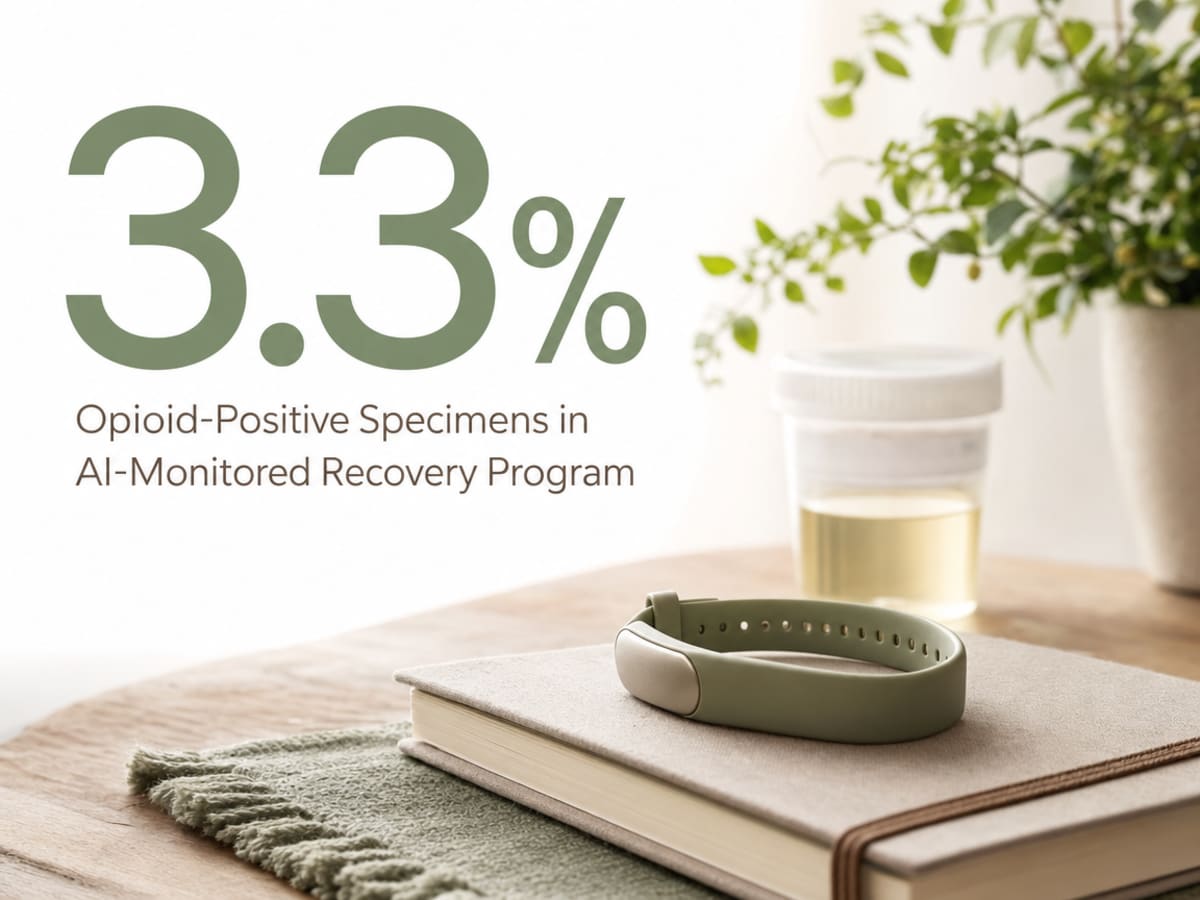

Opioid-Positive Specimens in AI-Monitored Recovery Program
Choosing a Program That Already Speaks the Language of Your License
By now the checklist writes itself. You are not looking for the prettiest website or the nearest facility. You are looking for a program that answers your license’s questions before you have to ask them.
Bring five questions to every intake call:5,13,21
- How do you handle 42 CFR Part 2 releases when a PHP, state intervention program, or credentialing body needs verification?
- What is your session cadence, and can it be certified for intermittent FMLA?
- Do you have direct experience coordinating with monitoring contracts, including toxicology chains of custody?
- What role does biometric data play in your clinical decisions, and who reviews it between sessions?
- What does your return-to-work planning look like at the six-month mark, not just at discharge?
If the person on the phone answers those five in specific, procedural language, you have found a program that speaks your license. If they answer in generalities, keep dialing.
Country Road Recovery built its outpatient model around exactly this reader. Make the call when you are ready. The first assessment is a schedule change, not a career event.
Start Your Recovery Journey Without Career Disruption
Connect with an admissions specialist who understands the unique challenges professionals face in seeking confidential care.
Frequently Asked Questions
Will my licensing board find out if I enter treatment on my own?
Not automatically. Federal law protects your SUD treatment records from disclosure in civil, criminal, administrative, and licensing proceedings without your specific written consent or a narrow court order. Your program cannot confirm you are a patient to a board investigator on its own. What triggers board involvement is usually non-compliance, an incident at work, or a mandatory report your license already requires. Voluntary entry, done early, generally stays private.13
Does FMLA actually cover time off for rehab, and can my employer retaliate?
Yes to the first, no to the second. Department of Labor guidance states FMLA leave may be taken for substance abuse treatment provided by a health care provider, though absence caused by the use itself is not protected. Your employer must keep the medical certification confidential and separate from your personnel file, and cannot retaliate against you for exercising FMLA rights. Enter treatment, and the legal posture shifts.14,21
How is a Physician Health Program different from being reported and disciplined?
A PHP is a confidential, non-punitive alternative to board discipline. Participants who enter voluntarily and stay compliant are typically evaluated, treated, and monitored without disciplinary action, and organized medicine advocates that fully compliant participants keep confidentiality when answering licensing and credentialing questions. Discipline is a public track. A PHP contract is a private clinical and monitoring agreement. Refusing recommendations or non-compliance is what shifts you from one to the other.18
Can I keep working while attending an intensive outpatient program?
That is what IOP is built for. Sessions run three to five days a week in early-morning or evening blocks so daytime work stays intact. FMLA can certify intermittent hours for treatment, with the certification kept confidential, and the ADA supports requesting a modified schedule as a reasonable accommodation while you are in recovery and no longer using illegal drugs. Solve transportation and childcare before week one.20,21
Are wearables and biometric monitoring reliable enough to prevent relapse?
Not as a standalone tool. A 2022 systematic review concluded that current evidence is insufficient to support routine remote monitoring of non-alcohol, non-nicotine SUDs through wearables alone. What they do well is add a continuous signal, sleep, heart rate, stress, that your clinician can act on between sessions, and early studies suggest physiological data can help predict near-term recurrence. Treat wearables as an assist, not a substitute for therapy and human accountability.1,6
What happens if I return to use during monitoring?
It is treated as a clinical event, not automatic termination. Return to use is common, especially in year one, where 33.9% of incidents occur, and 48.6% of healthcare professionals in monitoring experience at least one episode over the long term. Programs respond with reassessment, treatment intensification, and continued monitoring. By year five, 81.4% complete the program and 55.9% are working full-time in healthcare. Report it early; do not hide it.16
References
- Identifying Biomarkers of Drug Use Recurrence using Wearable Technologies and Ecological Momentary Assessment. https://pmc.ncbi.nlm.nih.gov/articles/PMC10416187/
- A Review of Wearable Biosensors in Alcohol Use Disorder Treatment. https://pmc.ncbi.nlm.nih.gov/articles/PMC8019775/
- Wearable and Wireless mHealth Technologies for Substance Use Disorders: A Systematic Review. https://pubmed.ncbi.nlm.nih.gov/33738178/
- Wearables Research for Continuous Monitoring of Patient Outcomes: A Scoping Review. https://pmc.ncbi.nlm.nih.gov/articles/PMC12063813/
- Artificial Intelligence-Enabled, Real-time Risk Monitoring for Substance Use Recovery in Veterans: An Initial Evaluation of the Behaivior Recovery Platform. https://pubmed.ncbi.nlm.nih.gov/40984129/
- Wearable remote monitoring to detect nonalcohol/nonnicotine substance use disorders: A systematic review. https://pubmed.ncbi.nlm.nih.gov/36062888/
- Wearable Technologies as a Tool for Alcohol Assessment and Intervention. https://alcoholstudies.rutgers.edu/wearable-technologies-as-a-tool-for-alcohol-assessment-and-intervention/
- Essential components of physician health program monitoring for substance use disorders. https://pmc.ncbi.nlm.nih.gov/articles/PMC9303734/
- Five year outcomes in a cohort study of physicians treated for substance use disorders in the United States. https://pmc.ncbi.nlm.nih.gov/articles/PMC2590904/
- Outcomes of Physicians with Substance Use Disorders in Physician Health Programs: A Narrative Review. https://pubmed.ncbi.nlm.nih.gov/32156222/
- Success Rates of Monitoring for Healthcare Professionals with Substance Use Disorder: A Meta-Analysis. https://pmc.ncbi.nlm.nih.gov/articles/PMC7828295/
- Intervention Program Requirements (California Board of Registered Nursing). https://www.rn.ca.gov/intervention/intreq.shtml
- 42 CFR Part 2 – Confidentiality of Substance Use Disorder Patient Records. https://www.ecfr.gov/current/title-42/chapter-I/subchapter-A/part-2
- elaws – FMLA Advisor: Substance Abuse. https://webapps.dol.gov/elaws/whd/fmla/10c9.aspx
- Success Rates of Monitoring for Healthcare Professionals with a Substance Use Disorder: A Meta-Analysis. https://pubmed.ncbi.nlm.nih.gov/33450803/
- Monitoring outcomes of substance use disorder among healthcare professionals. https://pubmed.ncbi.nlm.nih.gov/41401912/?fc=None&ff=20251218151410&v=2.18.0.post22+67771e2
- Oklahoma Statutes Title 43A. Mental Health. https://oksenate.gov/sites/default/files/2019-12/os43A.pdf
- American Medical Association – Resolution A-19-321 (Physician Health Programs Confidentiality). https://www.ama-assn.org/system/files/2019-05/a19-321.pdf
- Don’t ask don’t tell: substance abuse and addiction among nurses. https://pmc.ncbi.nlm.nih.gov/articles/PMC6415967/
- EEOC Enforcement Guidance: Reasonable Accommodation and Undue Hardship under the ADA. https://www.eeoc.gov/laws/guidance/enforcement-guidance-reasonable-accommodation-and-undue-hardship-under-ada
- Employer’s Guide to the Family and Medical Leave Act. https://www.dol.gov/agencies/whd/fmla/employer-guide


